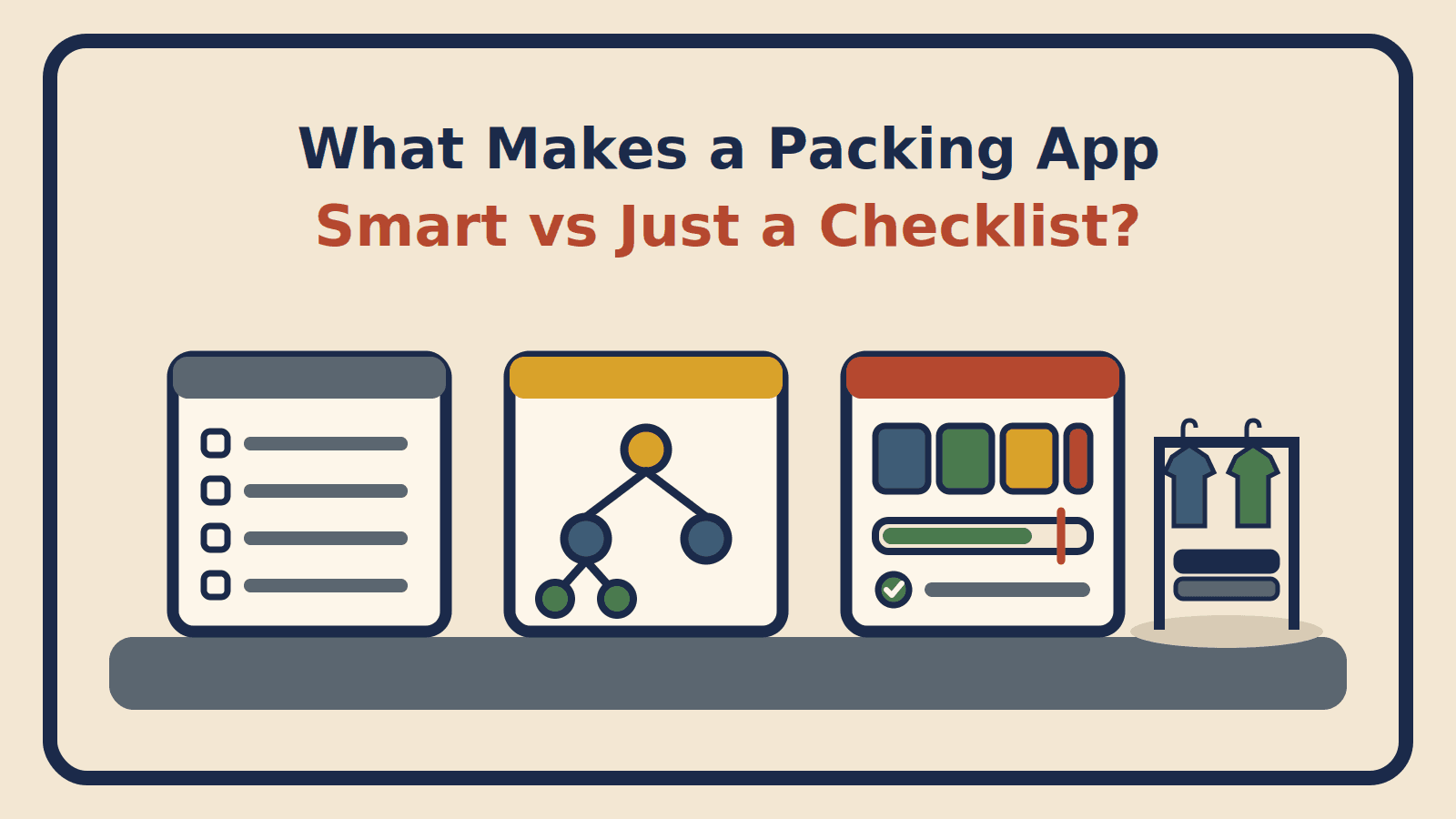
What Makes a Packing App "Smart" vs Just a Checklist?
September 21, 2026 · 4 min read
Prefer us on GoogleA packing app is smart if its decisions change when your trip changes. Weather icons, friendly design, and the word AI in the description don't count. The real test is whether the app adjusts quantities, names actual garments, and checks that they combine into outfits. Five quick tests show which kind of app you have.
Quick Answer
- Test 1: Enter five days, then ten. A checklist doubles the counts; a smart app doesn't.
- Test 2: Add laundry access. A smart app shrinks the list; a checklist ignores it.
- Test 3: Look at the output. "4 tops" is a checklist; four named shirts is a decision.
- Test 4: Check whether the picks form complete outfits, not just a pile of items.
- Test 5: Check whether anything limits the list to what your bag can hold.
Why "Smart" Is Hard to Judge From a Listing
Every packing app now describes itself as smart, intelligent, or AI powered. The labels tell you nothing, because a template with a weather rule on top can honestly be described that way.
Weather awareness is the most common claim and the weakest evidence. Long-standing checklist apps already add an umbrella when rain is forecast. That is a rule attached to a fixed list, not a decision about your trip.
The underlying difference between the two designs is covered in our comparison of AI packing apps and checklist apps. This guide is the practical version: tests you can run on any app in about ten minutes.
Test 1: Change the Trip Length
Build the same trip twice, once for five days and once for ten, and compare the clothing counts.
A checklist scales linearly. Five days of tops becomes ten days of tops, because the template multiplies by the day count. A smart app knows that clothes get reworn, so a ten-day list should be only modestly longer than a five-day one, not twice the size.
Test 2: Add Laundry Access
Take the ten-day trip and tell the app you can do laundry halfway through.
If nothing changes, the app has no quantity logic at all. Laundry access is the single biggest variable in how much clothing a trip needs, and an app that ignores it is not deciding anything about quantity.
Test 3: Read the Output
Look at what the list actually says. "4 tops, 2 pants, 1 jacket" is a category list. It hands the real decision back to you at the closet door.
A smart app names specific garments: the navy merino tee, the gray chinos. That requires knowing what you own, which means cataloging your wardrobe once. That setup cost is real, and it is the price of an answer you can act on without deciding anything further.
Test 4: Check Whether the Picks Combine
Take the named items and try to build an outfit for each day of the trip.
A list can be correct item by item and still fail as a wardrobe: three tops that only work with one pair of pants, or shoes that suit none of the evening plans. A smart app checks combinations before it shows you anything, because a pile of individually reasonable items is not the same thing as a set of outfits.
Test 5: Look for a Ceiling
Check whether anything stops the list from outgrowing your bag.
A generated list with no capacity limit can recommend more than a carry-on holds, and nothing flags it. Few apps handle this well, so treat it as a tiebreaker rather than a pass or fail. But an app that has never asked what bag you are bringing cannot know whether its list fits.
Common Mistakes
People assume weather awareness makes an app smart. In practice it is one rule on top of a template, because checklist apps have adjusted for rain for years without deciding anything else.
People assume a longer, more detailed list means a smarter app. In practice a smart app usually produces a shorter list, because its job is to remove what you won't wear.
People assume they need a smart app. In practice a personal checklist is the better tool if forgetting items is your main problem, as we cover in whether an AI packing app beats a human-made checklist.
How JetKit Handles the First Three Tests
JetKit was built around the tests a checklist fails. Trip length selects the quantity formula rather than multiplying by days, laundry access reduces the counts, and the output names specific garments from your cataloged closet. Hard rules remove combinations that don't work before anything is ranked. The full logic is laid out in how JetKit decides what to pack.
Frequently Asked Questions
What makes a packing app smart?
A smart packing app changes its decisions when the trip changes. It adjusts quantities for laundry access, names specific garments instead of categories, and checks that the pieces combine into outfits. An app that produces the same list with a weather icon added is a checklist, whatever its marketing says.
Is a packing app smart if it checks the weather?
Not by itself. Many long-standing checklist apps already add or remove items like an umbrella based on the forecast. Weather awareness is a rule layered onto a template, and a smart app needs to do more, such as adjusting counts and checking that clothes work together.
How can I test whether a packing app is actually smart?
Enter the same trip twice, once at five days and once at ten, then add laundry access to the ten-day version. If the clothing counts simply double and laundry changes nothing, the app is scaling a template. A smart app's ten-day list should be only modestly longer, and laundry should shrink it.
Do smart packing apps need to know what clothes I own?
To give specific answers, yes. Without your wardrobe, an app can only say four tops, not which four. Knowing what you own is what lets an app check that its picks actually combine into outfits, though it means cataloging your clothes once up front.
Related
More in AI Packing Apps.