Packing Apps With AI vs. Apps With Just Checklists: What's Actually Different
July 31, 2026 · 4 min read
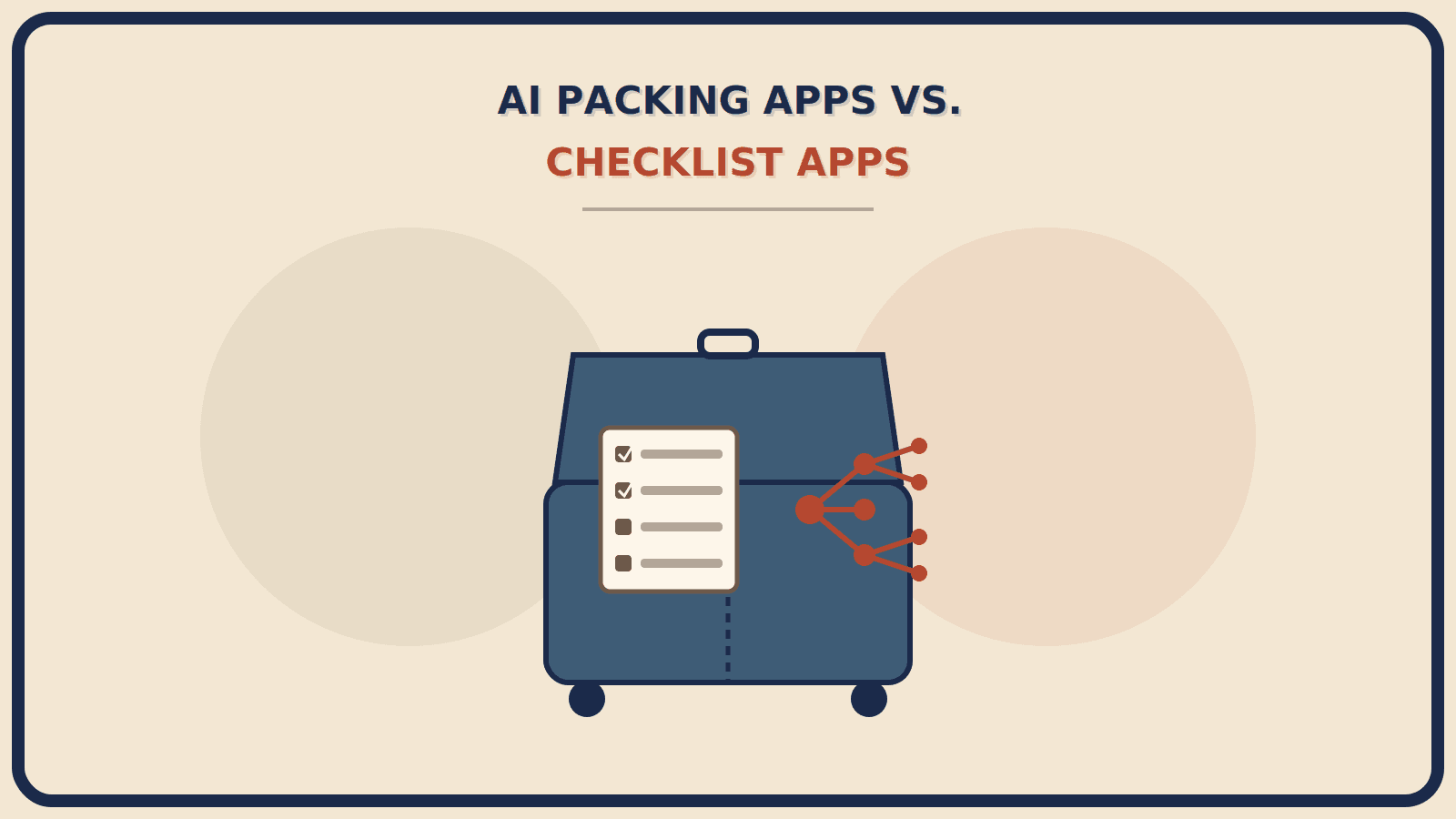
Prefer us on GoogleThe real category split between packing apps is worth stating plainly, independent of any specific app: a checklist-style app builds a list from a fixed catalog and rules configured by the user, while an AI-driven app generates the list by reasoning about the specific trip. That's a meaningfully different mechanism, not just a fancier interface wrapped around the same checklist.
Quick Answer
- Understand that checklist apps fill in a template from user-configured rules, while AI apps reason about the specific trip
- Evaluate any packing app on how its list is actually generated: on-device, in the cloud, or from a fixed catalog
- Check whether an account is required before a trip syncs, which platforms it runs on, and how it charges
- Don't over-weight on-device vs. cloud generation; list quality matters more in practice than where it's computed
- Expect AI-reasoning tools to handle open-ended trips, like one with no confirmed return date, better than fixed-catalog checklist apps
Why the Real Split Is the Generation Mechanism, Not the Interface
A checklist-style packing app builds a list from a fixed catalog and rules configured by the user, trip length, a rough weather band, planned activities, then lets items get checked off. An AI-driven packing app instead generates the list by reasoning about the specific trip, weather, activities, sometimes what's already owned, rather than filling in a template. That's the real difference worth understanding, and it holds up regardless of which specific apps are being compared.
An AI-competitor app's own comparison piece lays out a genuinely useful evaluation framework, even though its own app ranks first throughout and it links to its own store listing repeatedly. How the list is actually generated, on-device, in the cloud, or from a fixed catalog, matters more than any single feature, since it determines whether the app needs a live connection to build something new, and whether a trip's specific details leave the phone at all. Whether the app requires an account before a trip syncs, which platforms it actually runs on, and how it charges, subscription, one-time unlock, or a lifetime purchase, round out a genuinely useful checklist for evaluating any packing app on its own terms rather than by marketing copy.
Why On-Device vs. Cloud Gets More Weight Than It Deserves
The "on-device vs. cloud" distinction gets more marketing weight than most travelers actually need to care about. For the vast majority of people, whether an app builds its list on a phone's chip or on a server matters far less in practice than whether the resulting list is actually well-matched to the trip. An on-device app that generates a mediocre, generic list isn't meaningfully better than a cloud-based one that generates a genuinely well-reasoned list, privacy framing aside.
Common Mistakes
People assume an AI packing app is just a checklist app with a nicer interface. In practice, the generation mechanism is genuinely different, one fills in a configured template, the other reasons about the specific trip.
People assume on-device generation is automatically the better choice. In practice, list quality matters more than where the computation happens, so an on-device app with a generic list isn't better than a cloud app with a well-matched one.
People assume a company's own comparison of competing apps can be taken at face value. In practice, an app that ranks itself first and links to its own store listing repeatedly deserves skepticism on the specific rankings, even when the evaluation criteria underneath are genuinely useful.
People assume any packing app handles an open-ended trip the same way. In practice, fixed-catalog checklist apps struggle with trips that lack a defined length, while AI-reasoning tools handle that uncertainty better.
The deeper difference between AI-driven and checklist-driven tools shows up most clearly on a trip that doesn't fit a template in the first place. A trip with no confirmed return date is a genuinely hard case for a fixed-catalog checklist app, since those tools generally expect a defined trip length to configure their rules against. A tool built to reason about the actual, messier shape of a trip, rather than filling in a template built around a known start and end date, is better positioned to handle that kind of open-ended uncertainty than a rules-based checklist ever will be.
None of this requires guessing at which kind of packing app actually fits a given trip. JetKit reasons about the specific trip and a closet that's already on file rather than filling in a fixed template, which matters most exactly where a checklist app runs into trouble.
Frequently Asked Questions
What's the real difference between a checklist packing app and an AI packing app?
A checklist-style app builds a list from a fixed catalog and rules configured by the user, trip length, a rough weather band, planned activities. An AI-driven app instead generates the list by reasoning about the specific trip, weather, activities, and sometimes what's already owned, rather than filling in a template.
What should I actually look at when evaluating a packing app?
How the list is generated (on-device, in the cloud, or from a fixed catalog), whether it needs an account before a trip syncs, which platforms it runs on, and how it charges, subscription, one-time unlock, or lifetime purchase. That framework holds up regardless of which specific apps are being compared.
Does on-device vs. cloud generation matter for choosing a packing app?
It gets more attention than most travelers actually need to give it. Whether an app builds its list on a phone's chip or on a server matters far less in practice than whether the resulting list is actually well-matched to the trip.
Are AI packing apps better for trips that don't fit a normal template?
Yes, for open-ended trips, like one with no confirmed return date, a fixed-catalog checklist app struggles since those tools generally expect a defined trip length to configure their rules against. A tool built to reason about the actual, messier shape of a trip handles that uncertainty better.
Can I trust an app's own comparison of packing apps, including its competitors?
Treat the specific rankings with some skepticism if the app ranks itself first and links to its own store listing repeatedly, even if it discloses that upfront. The underlying evaluation criteria can still be useful even when the specific app-by-app scoring isn't neutral.
Related
More in AI Packing Apps.
- Best Apps for Building a Capsule Wardrobe Compared
- Best Apps for Tracking What's Actually in Your Suitcase
- AI Closet Apps vs. Traditional Wardrobe Apps: What's the Real Difference
- Best Packing Apps for Frequent Business Travelers Specifically
- Why Packing Lists From the Internet Never Quite Fit Your Trip