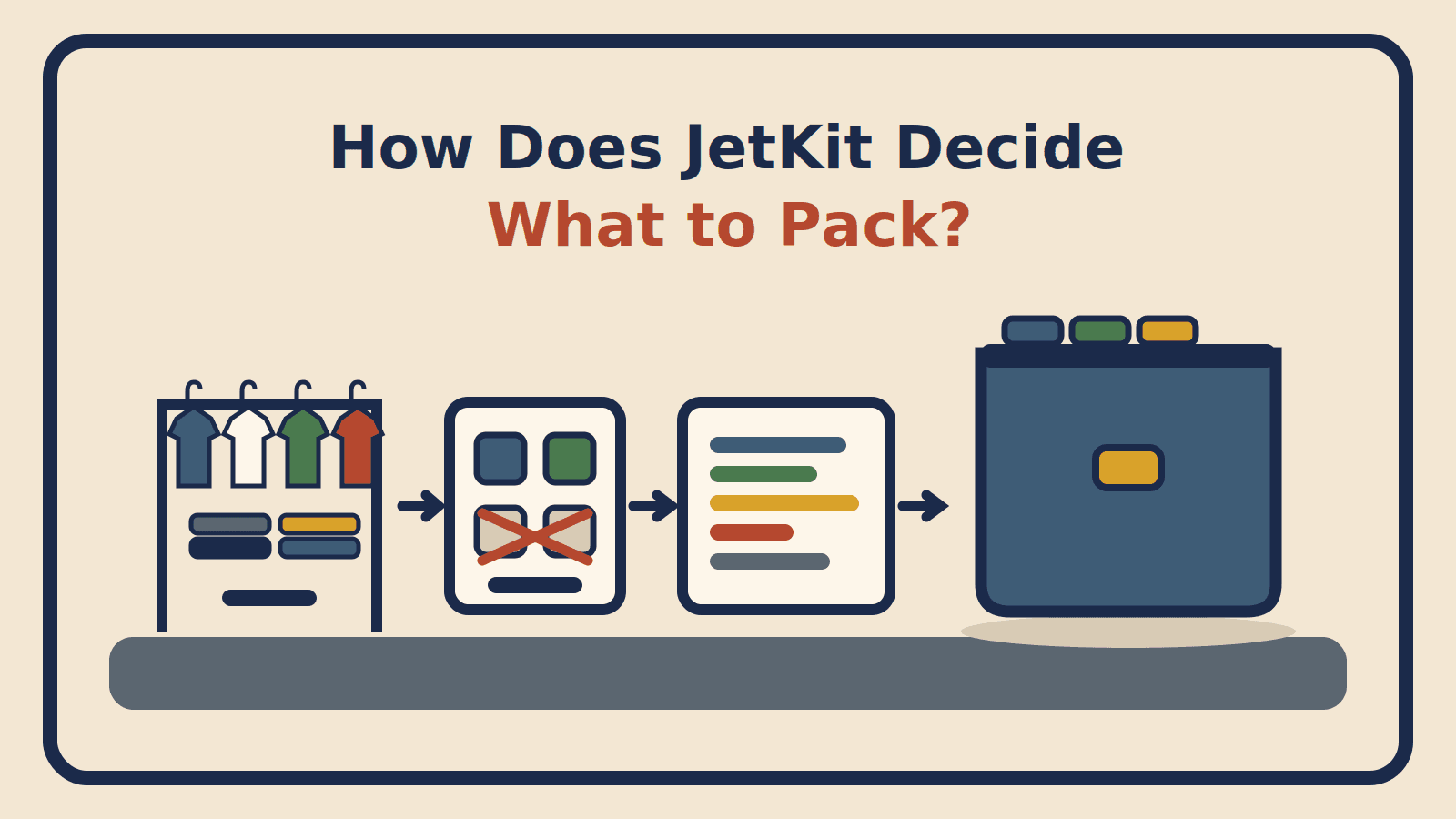
How Does JetKit Decide What to Pack?
September 9, 2026 · 6 min read
Prefer us on GoogleAsk most packing tools what to bring and you get a list of categories. Three shirts. Two pairs of pants. A rain layer.
Then you stand in front of an open closet and do the actual work yourself: which three shirts, do they go with the pants, is one of them the shirt you've failed to wear on four consecutive trips.
JetKit finishes that job. Here's exactly how.
Quick Answer
- Stage one: your cataloged wardrobe becomes the candidate set, real garments, not categories
- Stage two: hard rules eliminate combinations that are wrong regardless of score
- Stage three: what survives is scored across seven weighted dimensions
- Stage four: quantities come from trip structure, not a per-day multiplier
- The result names your clothes, in the right numbers, confirmed to work together
Stage one: it starts from your actual closet
This is the foundation, and it's the thing almost nothing else in the category has.
You catalog your wardrobe once. Photograph items and recognition extracts category, subcategory, color, material and pattern for each one. Photograph a complete outfit and it gets separated into its individual garments, each returned as its own item with its own attributes, which fills a new wardrobe far faster than adding pieces one at a time.
From that point on, every decision the system makes is made from clothes you own.
Color gets stored as a family rather than a raw value, and that detail does more work than it looks like. Navy and midnight blue are different numbers and functionally identical; two similar-looking mid-tones can clash badly. Comparing families rather than pixel values is what lets the system judge whether two pieces actually go together. Compatibility is graded rather than binary, strong, acceptable, incompatible, so a great pairing gets preferred without a merely fine one being forbidden.
Stage two: wrong combinations never reach the scoring
Some pairings are wrong no matter how well they score. Swimwear with formal footwear. Shorts with boots. Tailoring with beach shoes.
JetKit removes these by rule, before scoring runs at all.
That's a deliberate design decision and it's worth understanding why it matters. A purely score-driven system will eventually surface something ridiculous carrying a high number, because strong results across six dimensions can outweigh a catastrophic result on the seventh. Tuning weights doesn't fix that; it just moves where the absurdity appears. A hard filter does fix it.
There's a companion constraint on formality range. A selection mixing pieces from opposite ends of the formality scale reads as incoherent even when every individual item is appropriate on its own, so wide formality gaps get penalized rather than quietly averaged away.
Stage three: seven dimensions, weighted
Everything that survives the filter gets scored across seven dimensions rather than one blunt relevance number.
Occasion fit: does this suit what you'll actually be doing.
Weather fit: does it work in the destination's conditions.
Style cohesion: does the selection hold together as a set rather than as a pile of individually reasonable items. This carries the heaviest weight of the seven, deliberately, because a bag full of good pieces that don't combine is the most common way a technically correct packing list still fails you.
Preference: what you've told it you like, with favorites boosted.
Practicality: how the piece behaves in real use.
Versatility: how many days and contexts one item covers. This is what earns a garment its space, and it's why JetKit's lists come out shorter than lists built by counting days.
Freshness: how recently you've worn it. This exists specifically to stop the same three reliable pieces getting chosen on every single trip, which is the failure mode every scoring system drifts toward if you let it.
Swap an item and the replacement comes with a diversity bonus: a piece introducing a color the plan doesn't have yet outranks one duplicating something already selected. You get a genuine alternative, not a near-clone.
Stage four: quantities that reflect the trip, not the calendar
This is where nearly every packing list goes wrong, and it's the difference between a carry-on and a checked bag.
Quantities don't come from multiplying by days. Trip length selects an underlying formula, and which formula applies changes the shape of the result rather than just its size.
Laundry access reduces the counts rather than letting them scale linearly. That single adjustment is why a ten-day list lands barely longer than a seven-day one instead of proportionally larger. Anyone who's packed fourteen outfits for fourteen days has felt the cost of the alternative.
Packing mode shifts everything. Minimal pulls the counts down, comfort pushes them up. Same trip, same closet, different appetite for traveling light.
Base layers are handled separately, because underwear and socks are the only categories that genuinely scale one-to-one with days, and socks scale with activity on top of that. Generic lists treat every category the same and get two things wrong at once: too few socks and far too many pants.
The same trip always gives the same answer
The planning logic is deterministic. Identical inputs produce an identical plan.
That means the list doesn't shift underneath you between openings, and any change you notice traces back to something you changed, a date, an activity, an item in your closet, rather than the system quietly reconsidering.
It sounds like a small thing. It isn't. A list that varies each time you look at it is a list you can never build trust in, because you can't tell whether a missing item was a decision or noise.
What you actually get
A list naming the specific garments in your closet. In quantities that reflect trip length, laundry access and how light you want to travel. Confirmed to assemble into complete outfits rather than being a valid count of mismatched things.
No translating "four tops" into an actual decision at 11pm the night before. No unpacking a bag of clothes you never touched.
What it doesn't claim
It can't know about a one-off event you never mentioned. It isn't the final authority on local dress expectations, which is the category where AI systems generally are documented to be weakest, so verify those against local sources. And it needs your wardrobe cataloged first, which is real work, done once, and repaid on every trip after.
That's the honest boundary. Everything inside it, JetKit does properly.
For what "deciding" means as distinct from generating a list, see how AI decides what to pack. For the cataloging pipeline in detail, see can AI create a packing list from your own clothes.
Frequently Asked Questions
How does JetKit decide what to pack?
Four stages. Your cataloged closet becomes the candidate set, combinations that are simply wrong get eliminated by rule, everything that survives is scored across seven weighted dimensions, and quantities come from trip length, laundry access and packing mode rather than a per-day multiplier.
How is this different from other packing apps?
Other apps tell you to pack three shirts. JetKit tells you which three, from the shirts hanging in your closet, and confirms they work with the pants it picked. That's a different operation, and it requires knowing your wardrobe, which category-based lists structurally cannot do.
Why eliminate combinations by rule instead of scoring them low?
Because scoring alone will eventually surface something absurd with a high number attached, since strong results on six dimensions can outweigh a catastrophic result on one. Swimwear with formal shoes isn't a close call to be ranked. It's wrong, so it's removed before scoring ever runs.
What does JetKit score items on?
Seven weighted dimensions: occasion fit, weather fit, style cohesion, your stated preferences, practicality, versatility across multiple days, and freshness. Style cohesion carries the heaviest weight, because a bag of individually good pieces that don't combine is the most common way a technically correct list fails you.
How does JetKit work out quantities?
Trip length selects an underlying formula instead of multiplying by days, laundry access reduces those counts rather than letting them scale linearly, and packing mode shifts the whole result toward minimal or comfortable. It's why a ten-day list comes out barely longer than a seven-day one.
Related
More in Building a Travel Wardrobe.