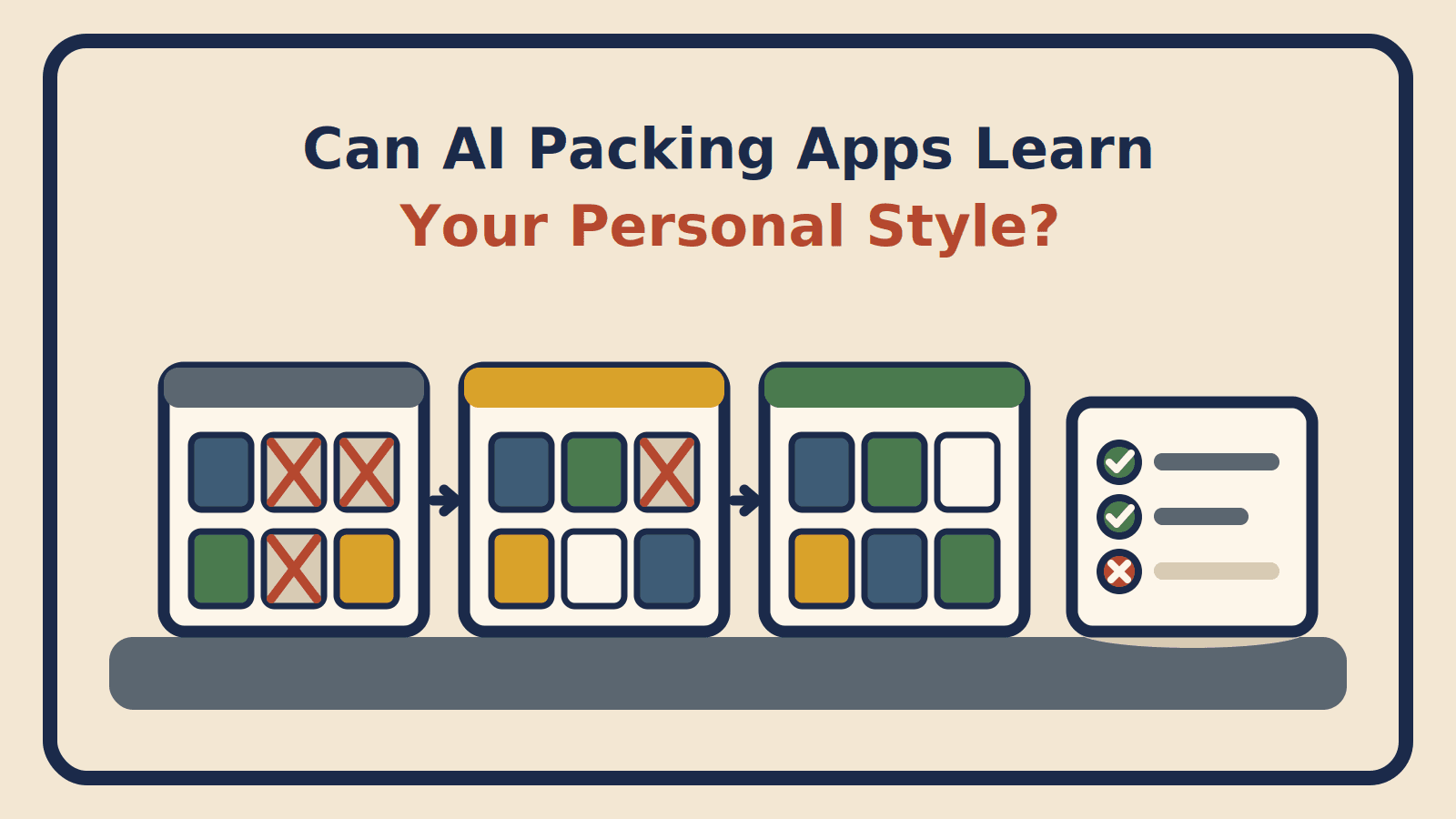
Can AI Packing Apps Learn Your Personal Style?
September 9, 2026 · 5 min read
Prefer us on GoogleYes, partly, and the interesting part is which half is learnable. These systems get to your preferences much faster than they get to your style, and there's a specific reason packing is better positioned for this than the fashion apps you'd expect to be ahead.
Quick Answer
- Preferences are learnable quickly; style as an aesthetic identity is slower
- Packing produces explicit rejection signal, which shopping recommenders rarely get
- Data is sparse: six to ten trips a year, not hundreds of choices a week
- Style is context-dependent, so a single style model is wrong by construction
- The extremes separate first: items you never wear and items you always reach for
The Advantage Packing Has
Fashion recommendation is a hard problem, and the research literature is clear about why. A survey of modern fashion recommender systems identifies sparse purchase data as a core challenge, alongside the fact that precise product information often isn't available.
There's a subtler problem underneath it, known in the field as one-class collaborative filtering. Shopping recommenders observe only positive implicit feedback: what you bought. They never see what you considered and passed on. So a garment you didn't buy is indistinguishable from a garment you never encountered, and the system has to guess which.
Packing inverts this. When the app suggests an item and you swap it out, that's an unambiguous no, because you saw it, you considered it, you removed it. When an item goes in the bag and comes home unworn, that's a rejection revealed by behavior rather than stated.
Negative signal is scarcer and more informative than positive signal in almost every recommender context. Packing generates it as a byproduct of normal use, which is a genuine structural advantage over apps that only see purchases.
The Limit, Stated Honestly
Sparsity is severe and there's no way around it.
A music service observes hundreds of choices a week. A packing app observes six to ten trips a year. That's two orders of magnitude less data, and no modeling technique manufactures signal that isn't there.
Which means learning is slow by necessity. The extremes separate first. An item you've packed four times and never worn is unambiguous, as is one you reach for every trip. Nuance takes considerably longer. Any app suggesting it understands your taste after two trips is describing marketing rather than data.
There's a second confound worth naming. Wearing something doesn't always mean preferring it. You may have worn that shirt because it was the only clean one, or because the weather turned. A system reading every wear as endorsement will overfit to circumstance.
Why Style Is Harder Than Preference
These get treated as the same thing and they aren't.
Preference is item-level. You like this jacket. You never wear those pants. That's directly observable and it's most of the practical value, because a list that stops suggesting the four things you never touch is measurably better than one that doesn't.
Style is a pattern across items: an aesthetic you'd recognize but might struggle to articulate. Learning it requires inferring the abstraction from the instances, which needs far more data than learning the instances themselves.
And style isn't singular. What you wear to a client dinner and what you wear on a weekend away are different, and both are authentically you. A system modeling one "your style" is wrong by construction. This is exactly why occasion has to be scored as its own dimension rather than being folded into preference: the same item can be right for one context and wrong for another, and that's information, not noise.
How JetKit Learns
Four signals, deliberately, because no single one is reliable on its own.
What you state. Explicit preferences you set, which give the system something to work with before any behavioral data exists. This is the standard answer to cold start: content and stated attributes carry the early trips until behavior accumulates.
What you favorite. A direct positive marker, weighted into scoring so favorited pieces are preferred without dominating outright.
What you actually wore. The strongest behavioral signal, and the one most systems never see. Items that repeatedly come home unworn are items the scoring should stop selecting.
What you swapped out. The clearest rejection available. When you swap, the replacement is chosen with a diversity bonus, so a piece introducing a color the plan doesn't have outranks one duplicating something already selected. You get a real alternative rather than a near-clone of what you just rejected.
There's also a freshness dimension, which works against the others on purpose. Left alone, any scoring system collapses onto the same handful of high-scoring items and packs them every trip. Freshness penalizes recent selections so the plan keeps circulating through your wardrobe rather than converging on a uniform.
And corrections persist. When recognition mislabels an item and you fix it, that correction is kept rather than discarded, which improves accuracy on exactly the ambiguous items a generic model handles worst, namely yours.
What to Expect Realistically
After a few trips: the obvious stuff. Items you never wear stop appearing. Items you favor appear more often.
After a dozen: combination-level patterns. Which pairings you accept, which you consistently break up.
What it won't do: read your mind about a piece you've never packed, or know that your taste shifted last month until you show it. Those are limits of the data rather than the modeling, and any app claiming otherwise is claiming something the signal doesn't support.
For the full decision mechanism these signals feed into, see how JetKit decides what to pack. For what separates a genuinely adaptive system from a branching checklist, see what makes a packing app smart.
Frequently Asked Questions
Can a packing app really learn my style?
It learns your preferences considerably faster than it learns your style. Which specific garments you favor, which you never wear, and which combinations you reject are all learnable from a handful of trips. Style as an aesthetic identity is slower, because the signal is sparse and it changes with context.
How does an app learn what I like without me telling it?
From behavior. Swapping a suggested item out is an explicit rejection. An item that comes home unworn is a revealed rejection. Items you reach for repeatedly are a positive signal. Rejection is the more informative of the two, and packing generates it naturally in a way shopping doesn't.
Why is learning style harder than learning preferences?
Two reasons. Data is sparse, since most people take six to ten trips a year rather than making hundreds of choices a week. And style isn't one thing: what you wear to a client dinner and what you wear on a weekend away are different, so a single style model is wrong by construction.
How many trips before it gets good?
Preference signal accumulates fastest on the extremes, so items you never wear and items you reach for constantly separate out within a few trips. Nuance takes longer. Any app claiming to understand your style after two trips is overstating what the data supports.
What does JetKit use to learn?
Four signals: preferences you state directly, items you mark as favorites, what you actually wore versus what came home untouched, and what you swapped out. It also tracks how recently each item was chosen, so the same reliable pieces don't get selected on every trip.
Related
More in Building a Travel Wardrobe.