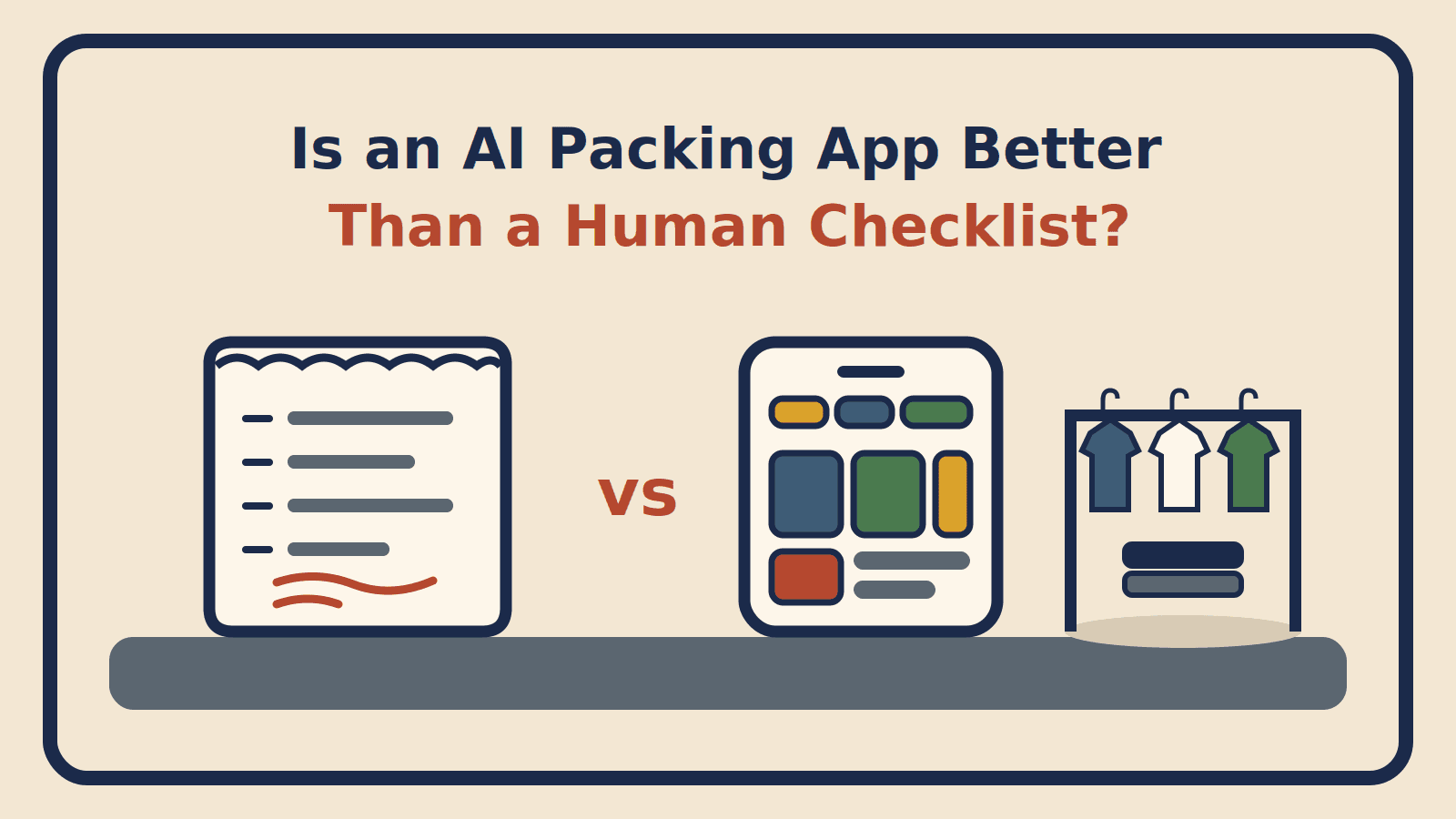
Is an AI Packing App Better Than a Human-Made Checklist?
September 6, 2026 · 5 min read
Prefer us on GoogleThe honest answer is that they aren't competing. A checklist and a packing app answer two different questions, and knowing which question is actually causing you trouble tells you which one you need.
Quick Answer
- A checklist answers "what did I forget"; an app answers "how many, and which ones"
- A refined personal checklist is genuinely excellent at the first question
- No static list can adapt to trip length, laundry access, or unusual conditions
- Generic AI lists adapt but don’t know your wardrobe or your habits
- The version that does both has to accumulate your history, not just generate output
Two different jobs
The checklist is a memory tool. Its function is preventing omission, and a personal list refined over years is very good at it. It carries knowledge that exists nowhere else: that the outlets in your usual hotel are recessed, that you always forget lip balm on flights, that the gym at the office you visit doesn't supply towels.
That's not generic knowledge, and no model has it. If forgetting things is your failure mode, a checklist you built yourself is the correct answer and an app will mostly annoy you.
An AI list is a decision tool. Its function is working out what a specific trip requires: how many tops for eleven days with one laundry stop, whether the destination needs a shell, which pieces work across a mixed itinerary.
That's arithmetic a checklist can't do, because a checklist is a fixed artifact and every trip is different.
Where each one fails
The checklist's failure is that it never adapts. It was written once, and a five-day trip and a two-week trip get the same list.
People solve this by building for the worst case. The list contains everything any version of the trip might need, so it's safe, and you carry that surplus on every trip regardless. That's the mechanism behind the familiar figure that a large share of travelers come home with clothes they never wore. It isn't carelessness, it's a static list doing exactly what it was designed to do.
The generic AI list's failure is that it doesn't know you. The most consistent criticism of AI trip planning across industry commentary is that the same request produces roughly the same answer for a solo traveler and a family of four. Constraints in the prompt help, but the tool doesn't remember your last trip, doesn't know you run cold, and has never seen your closet.
There's a second, structural failure: without knowing your bag's capacity, a generated list has no ceiling. It can exceed the space available and nothing flags it, which is why the final edit still lands on you.
Where JetKit fits
The interesting position is the one that does both jobs, and that requires a specific architecture rather than better prompting.
It starts from your actual wardrobe. Items are cataloged once, with recognition extracting category, color, material and pattern. That makes the output specific garments rather than categories, which is the difference between "four tops" and a list you can act on without further decisions.
It computes quantities from trip structure rather than day count. Trip length selects the underlying formula, laundry access reduces the counts rather than letting them scale linearly, and a packing mode shifts the result toward minimal or comfortable. This is the part a checklist structurally cannot do, and it's why a ten-day list ends up only slightly longer than a seven-day one instead of proportionally larger.
It checks that the selection works together. Candidate combinations are filtered by hard rules first, eliminating pairings that are simply wrong regardless of score, then scored across several dimensions: suitability for the occasion, fit with the destination's conditions, how coherent the pieces look together, your stated preferences, practicality, versatility across multiple days, and how recently you've worn something. Color is compared by family rather than raw value, so navy and midnight blue read as compatible while two clashing mid-tones don't.
And it accumulates. This is the part that closes the gap with a good personal checklist. Corrections you make to recognition are retained rather than discarded. Items that repeatedly come home unworn are items the scoring can stop selecting. The freshness dimension exists specifically so the same pieces don't get chosen trip after trip.
That accumulation is what turns a decision engine into something closer to your own refined list. A generic AI list starts from zero every time. A system that keeps your history gets more like your list with each trip while still adapting to each new set of conditions.
The honest cost: cataloging a wardrobe takes time, and nobody has removed that. It's a one-time investment that pays back across every subsequent trip, which is precisely why this approach suits frequent travelers and doesn't suit someone taking one trip a year.
Which one you should use
Stick with your checklist if you travel infrequently, take similar trips each time, and your existing list works. There's no reason to fix that.
Use both if forgetting non-clothing items is your problem and overpacking clothes is also your problem. They barely overlap, and a personal list for gear alongside an app for the wardrobe is a reasonable division.
Use a wardrobe-aware app if the recurring frustration is standing at an open closet with a list that says "four tops" and no idea which four, or unpacking a bag full of things you never touched.
For the accuracy question specifically, including how you'd measure whether any list worked, see how accurate is an AI packing list.
Frequently Asked Questions
Is an AI packing app better than a checklist?
They solve different problems. A checklist is a memory tool that stops you forgetting things, and a well-refined personal one is excellent at that. An AI list is a decision tool that works out quantities and selections for a specific trip. The checklist can't adapt; the generic AI list doesn't know you.
When is a paper checklist genuinely better?
When you take the same kind of trip repeatedly and have refined a list over years. That list contains lessons no software knows, like which adapter fails at your usual hotel. If you travel twice a year and your list works, an app has little to offer you.
What can't a checklist do?
Adapt. A static list has no way of knowing this trip is ten days rather than five, that you'll have laundry access midway, or that the destination is warmer than usual. So people build the list for the worst case and carry that surplus on every trip.
Do AI packing apps actually reduce overpacking?
Only if they know what you own and how much space you have. A generated list with no capacity ceiling and no knowledge of your wardrobe can exceed your bag freely. The reduction comes from quantity logic tied to real garments, not from the list being AI-generated.
Can you use both together?
Yes, and it's a reasonable approach. Use a personal checklist for the non-clothing items you've learned to bring, and an app for the clothing decisions, where quantities and combinations matter most. The two failure modes barely overlap.
Related
More in Building a Travel Wardrobe.