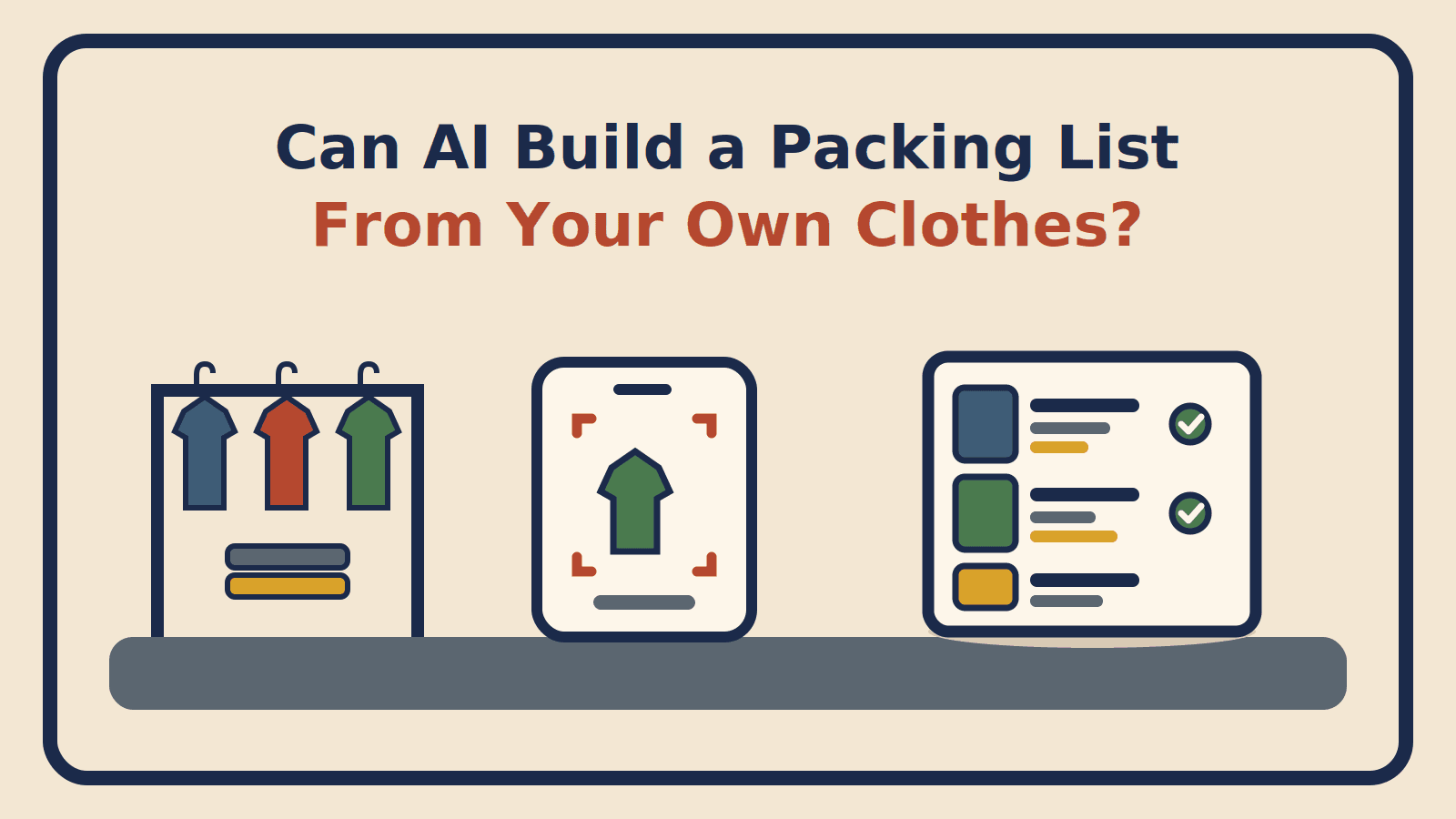
Can AI Create a Packing List From Your Own Clothes?
August 29, 2026 · 5 min read
Prefer us on GoogleThe short answer is yes. The longer answer is that choosing what to pack from a known wardrobe is the easy half of the problem. The hard half is that your wardrobe isn't known: it's fabric hanging in a room, and nothing about it is legible to software until someone makes it so.
Quick Answer
- AI can pack from your clothes only once those clothes exist as structured data
- Cataloging is the real barrier, and it's a genuine one-time cost nobody has removed
- Recognition needs to extract category, color, material and pattern, not just identify "a shirt"
- Color has to be normalized into families before compatibility can be judged
- Corrections should improve the system rather than being discarded
The four steps between a closet and a list
Capture. Getting garments into the system at all. Photographing items individually is the baseline, and background removal makes the results usable. Some tools accept forwarded order confirmations or pasted product links, which skips photography for anything bought online. Bulk approaches like filming a closet and extracting frames are more efficient in principle and harder in practice, because the same shirt appearing in forty frames has to be recognized as one shirt rather than forty.
Recognition. Identifying what each item is. Not "a top" but a category, a subcategory, a color, a material, a pattern. That granularity matters downstream: a merino long-sleeve and a heavy cotton hoodie are both tops, and they behave completely differently when the system is calculating how many you need.
Normalization. Making the extracted data comparable. This step is invisible and it's where a lot of naive implementations fall over. Two garments can't be judged compatible by comparing raw color values, because navy and midnight blue are different numbers and identical in practice, while two similar-looking mid-tones can clash badly. Color has to be grouped into families before any compatibility judgment is possible. The same applies to formality: a system needs a comparable scale, not just labels.
Selection. Only now can anything be decided. With a catalog of typed, normalized garments, the trip's conditions become constraints and the packing list becomes a scoring problem.
Skip any of the first three and you're back to generating categories.
Where it genuinely struggles
Ambiguous items. Recognition is reliable on a white dress shirt and unreliable on something with no clear category. When the extracted subcategory comes back as generic, downstream steps have very little to work with, and results degrade in ways that look strange rather than merely wrong.
The cold start. A system with five items in it can't do much. This is the first-run problem for every wardrobe tool, and it's why approaches that extract multiple garments from a single photo of a full outfit are valuable: they get a useful catalog faster.
The honest cost. Cataloging takes time. Tagging automation reduces it substantially but doesn't remove it. If you take one trip a year, that investment probably isn't worth it and a good checklist app will serve you better.
What JetKit does, in detail
Building the catalog. Items go in by photograph, with recognition extracting category, subcategory, color, material and pattern for each one. There's also a route that takes a photo of a complete outfit and separates it into its constituent garments, returning each as an individual item with its own attributes, which gets a new wardrobe to a useful size much faster than one-at-a-time entry.
Making garments comparable. Color is stored as a family rather than a raw value, which is what allows the system to judge whether two pieces work together. Compatibility is graded rather than binary, running from strong through acceptable and weak to incompatible, so the scoring can prefer a strong pairing without treating a merely acceptable one as forbidden.
Filtering before scoring. Some combinations are wrong no matter how well they score, so they're eliminated by rule rather than ranked. Swimwear with formal footwear, shorts with boots, formal garments with casual shoes. This exists because a purely score-based system will occasionally surface something absurd with a high number attached, and a hard filter is the correct fix rather than more tuning.
Scoring the candidates. Surviving combinations are evaluated across several dimensions rather than one: suitability for the occasion, fit with the destination's weather, how coherent the pieces look together, your own preferences, practicality and comfort, how versatile a piece is across multiple days, and freshness, which prevents the same items being selected trip after trip.
Setting quantities. Trip length selects the underlying formula, laundry access reduces the counts rather than leaving them to scale linearly, and a packing mode shifts the whole result toward minimal or comfortable. This is what makes a ten-day list only slightly longer than a seven-day one instead of proportionally larger.
Learning from corrections. When recognition gets an item wrong and you fix the label, that correction is retained rather than discarded. Over time it improves accuracy on the kinds of items that are hardest to classify, which are precisely the ones a generic model handles worst.
The result is a list naming specific garments you own, in quantities matched to the trip, that assemble into complete outfits.
For the decision side of this, including why generating a list and deciding what to pack are different operations, see how AI decides what to pack.
Frequently Asked Questions
Can AI really build a packing list from clothes I already own?
Yes, provided your clothes exist in the system as structured data first. That's the actual barrier: a model can reason about a cataloged wardrobe, but it can't see inside your closet. Every tool that does this well requires you to catalog your clothes once, and every tool that skips that step is outputting categories rather than garments.
How do I get my wardrobe into an app?
Photographing items is the common route, with background removal and automatic tagging handling most of the work. Some tools also accept forwarded shopping receipts or pasted product links, which skips photography entirely for anything bought online.
How accurate is AI at recognizing clothing?
Good on clear categories like a navy button-down, less reliable on unusual or ambiguous items where the category itself is vague. This is why well-designed systems ask you to confirm rather than silently accepting their own guess, and why corrections matter.
How long does it take to catalog a wardrobe?
It's the real cost of the approach and nobody has eliminated it. It's a one-time investment that pays back across every subsequent trip, which is why wardrobe-based packing suits frequent travelers considerably better than occasional ones.
What does JetKit do with my clothes once they're in?
It extracts attributes for each garment, normalizes color into families so pieces can be compared for compatibility, filters out combinations that are simply wrong, then scores the remaining candidates against your trip's conditions across several dimensions and sets quantities based on trip length and laundry access.
Related
More in Building a Travel Wardrobe.