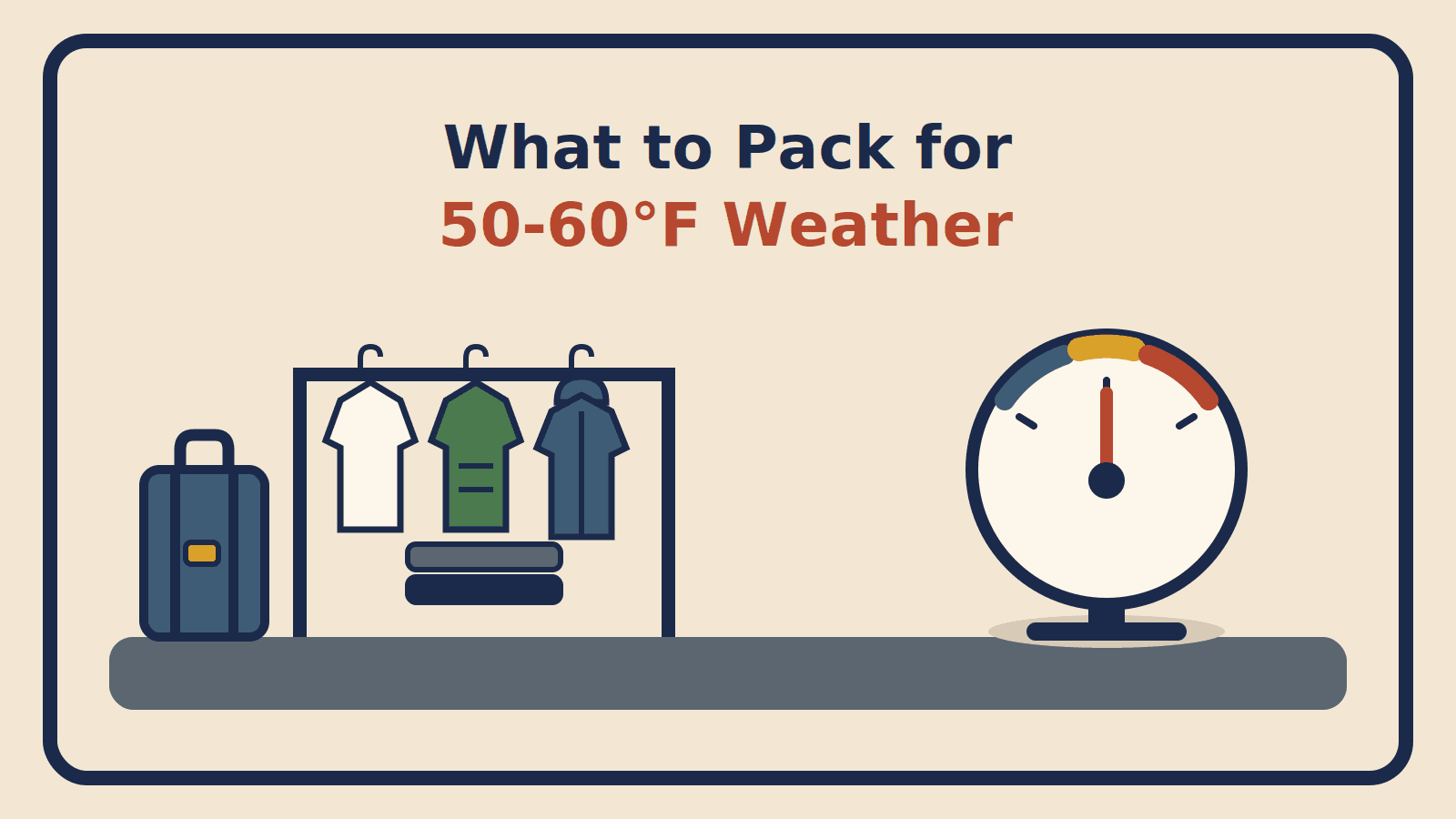
What Clothes Should I Pack for 50–60°F Weather?
August 27, 2026 · 4 min read
Prefer us on GoogleFifty to sixty degrees is the trickiest band on the thermometer, and there's a clean piece of evidence for why: the National Weather Service only begins calculating wind chill at 50°F. That's the official boundary where meteorologists decide wind has started meaningfully changing how cold it feels. You're packing for the exact range where the number stops being a reliable guide.
Quick Answer
- Pack a system, not an outfit: long-sleeve base, light mid layer, wind-resistant shell
- At 58°F the mid layer is optional; at 51°F you want all three
- Wind matters more than the reading, which is why 50°F is where wind chill charts begin
- If you'll be moving, dress as though it's 10 to 20 degrees warmer
- Bottoms barely change across the band; a single pair of pants covers it
Why the Number Misleads You
Three variables move perceived temperature more than the forecast does in this range.
Wind. The wind chill index starts at 50°F for a reason. Below that threshold, moving air strips heat from exposed skin fast enough that forecasters consider it worth quantifying. A still 52°F and a windy 52°F are not the same weather, and a wind-resistant outer layer does more for you here than a warmer but permeable one.
Sun. Direct sun on a clear day adds a real and substantial amount to how warm you feel, particularly on still days and particularly in darker clothing. The same 55°F reading in morning shade and afternoon sun can feel like a ten-degree gap.
Activity. This is the biggest one, and it's why running guidance has long recommended dressing as though it's roughly 10 to 20 degrees warmer than the actual reading. Core body temperature rises within the first several minutes of moderate exercise, so what feels correct standing at the door feels stifling fifteen minutes into a walk. Fifty-five degrees walking and fifty-five degrees waiting for a bus require different clothing.
Put those together and the useful conclusion is that you can't pack an outfit for this band. You pack a system with a removable middle.
The Three Layers
Base. A long-sleeve tee, lightweight merino, or a button-down. Merino and synthetics are the better choice here specifically because this is the band where you'll warm up and cool down repeatedly; cotton is comfortable dry but loses insulating value once damp.
Mid. A light knit, fleece, or cardigan. This is the variable layer, and it's the one that comes off. At the top of the range you may not need it at all; at the bottom it's doing most of the work.
Shell. A light wind-resistant jacket or structured overshirt. Not an insulated coat. The job here is blocking wind and light rain, not adding warmth, and something that packs into a bag matters more than something warm you'll end up carrying.
Bottoms are the easy part. One pair of pants or jeans covers the entire band, which is worth noting because it's the category people wrongly assume needs adjusting for temperature.
Common Mistakes
People pack a proper winter coat because the number sounds cold. At 50-60°F an insulated coat is overkill, and the practical result is carrying it for most of the day.
People leave the outer layer at home because the afternoon forecast looks pleasant, then get caught when the sun drops behind cloud or the wind picks up late afternoon. A packable shell weighs almost nothing and is the single highest-value item in this range.
People dress for standing still and then go for a walk. If your day involves any sustained movement, start slightly cool. Feeling slightly underdressed for the first five minutes is the correct calibration, not a mistake.
People default to cotton throughout. It's fine for a dry day with steady activity levels, but this is precisely the band where you're most likely to sweat lightly and then cool down, which is where cotton performs worst.
Packing It for a Trip
For a trip where the forecast sits in this band, the whole thing is one base layer per day, one or two mid layers, and one shell. That's a small addition to a normal wardrobe rather than a separate cold-weather kit, which is why 50-60°F trips fit in a carry-on easily as long as you resist the coat.
If your forecast spans this band and something significantly warmer or colder, that's a different problem. See our guide to packing when the layers have to do all the work for how to build a system that stretches further, and packing for unpredictable daily weather for when the forecast itself isn't reliable.
Frequently Asked Questions
What should I wear in 50-60 degree weather?
A three-part system: a long-sleeve base layer, a light mid layer like a knit or fleece, and a wind-resistant shell. At the top of the range the mid layer becomes optional and the shell is insurance; at the bottom you'll want all three. The bottoms barely change across the band.
Is 50-60°F cold or mild?
Both, depending on conditions rather than the number. Standing still in wind at 52°F feels genuinely cold; walking briskly in sun at 58°F feels warm. This band has the widest gap between the thermometer reading and how it actually feels, which is why a single fixed outfit rarely works.
Do I need a coat in 50-60 degree weather?
Not a heavy one. A light jacket, overshirt, or wind-resistant shell handles this range. A proper insulated coat is overkill and you'll end up carrying it, which is worse than being slightly cool for ten minutes.
Why does 55°F feel colder some days than others?
Wind and sun. The National Weather Service only begins calculating wind chill at 50°F and below, which tells you this is exactly where wind starts meaningfully changing perceived temperature. Direct sun works the other way and can add the equivalent of several degrees.
What fabrics work best in this range?
Merino wool and synthetics for anything worn next to skin, because this is the band where you're most likely to warm up and cool down repeatedly. Cotton is comfortable when dry but loses insulating value once damp, which matters if you're moving between activity and standing still.
Related
More in Packing for Weather.