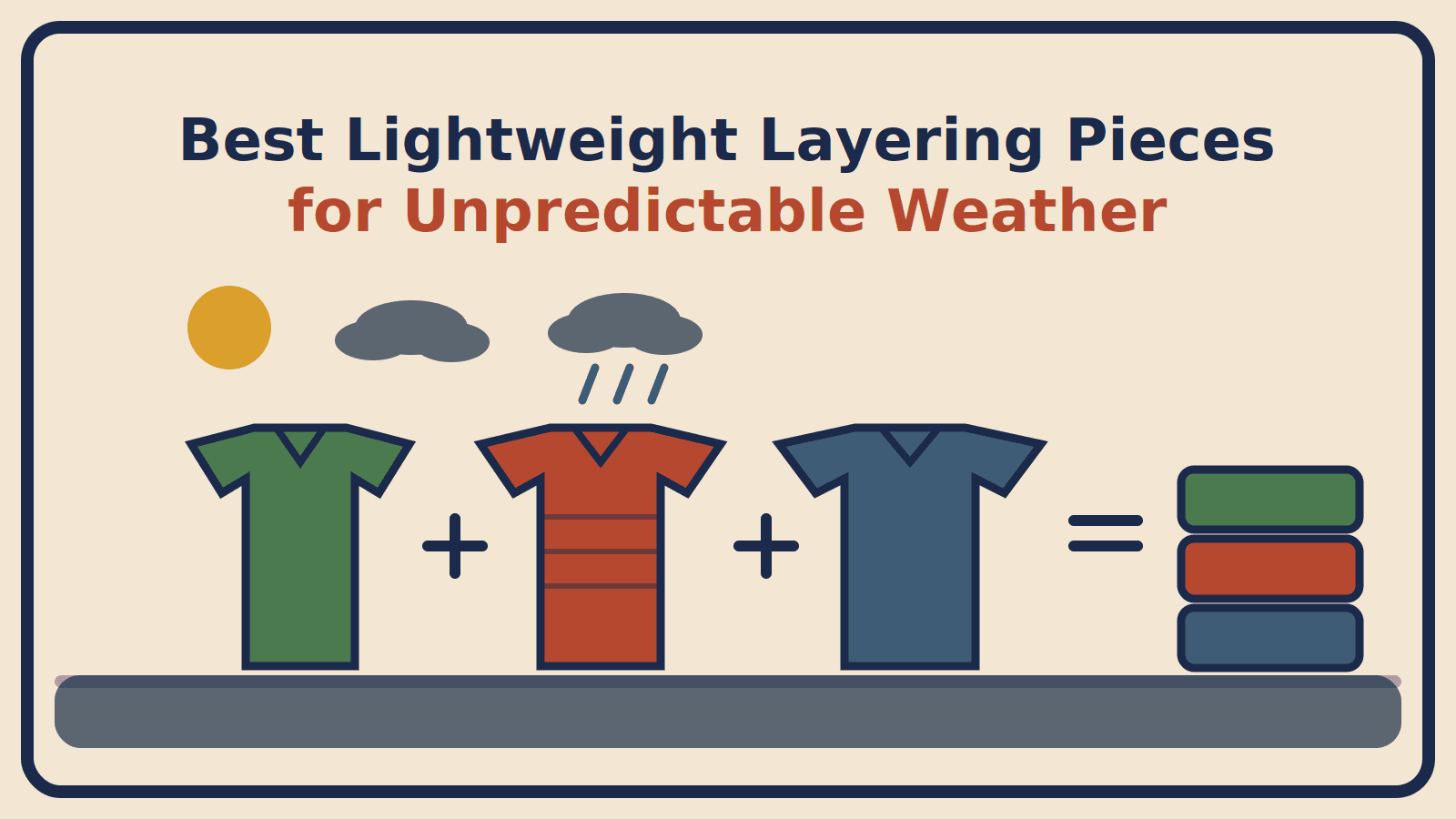
Best Lightweight Layering Pieces for Unpredictable Weather
August 17, 2026 · 6 min read
Prefer us on GoogleUnpredictable weather is not solved by one warm garment. It is solved by having several distinct states available, which is what three thin layers give you and a single coat does not. Get each layer's job right, and the whole system packs smaller than the coat it replaces.
Quick Answer
- Base layer: merino for odor resistance, synthetic for faster drying and lower cost
- Mid layer: grid fleece for breathability, thin synthetic puffy for more warmth per gram
- Shell: windproof for most trips, waterproof when sustained rain is likely
- Never cotton in the system, since it stops insulating once damp
- Three pieces produce several usable warmth levels, which is the actual goal
- Merino base layers: Icebreaker and Smartwool are the reference points
- Grid fleece: Patagonia R1 style, breathable and dries fast
- Thin synthetic puffy: Patagonia Nano Puff or Arc'teryx Atom, warm when damp
- Ultralight down: Uniqlo Ultra Light Down for value, Mountain Hardwear Ghost Whisperer for weight
- Windshell: Patagonia Houdini or Black Diamond Alpine Start, packs to a fist
- Look for pieces that layer without bunching, so cuffs and hems matter
- Skip the single heavy coat unless the forecast is reliably cold
Why three thin pieces beat one warm one
A coat gives you two settings: on and off. If the day runs from a cold morning through a warm afternoon into a windy evening, neither setting is right for most of it. Three thin layers give you roughly eight combinations, and about four of those are genuinely distinct comfort levels. That is the real argument for layering, and it has nothing to do with the outdoor-industry aesthetic.
Each layer has one job. The base manages moisture against your skin, which is why cotton is disqualified: it absorbs, dries slowly, and stops insulating once damp, which is exactly what happens when a cool morning turns into a brisk walk. Merino handles this well and resists odor, letting you re-wear it; synthetics dry faster and cost less.
The mid layer traps air. Grid fleece breathes well and dries quickly, so it suits active days and damp conditions. A thin synthetic puffy is warmer for its weight and blocks more wind, but it breathes less. Ultralight down is the warmest and smallest-packing of the three, and the one that fails when wet.
The shell blocks weather, and here most travelers over-buy. Wind strips heat far faster than light rain wets you, and a windshell packs to the size of a fist, so a windproof layer solves more travel days than a heavy waterproof one. Carry a genuine waterproof shell when the forecast has sustained rain or when arriving wet has consequences; otherwise a windshell and an umbrella weigh less and work better in a city.
Two details decide whether the system actually works. Cuffs and hems determine whether layers slide over each other or bunch, so try the combination rather than the pieces. And the base and mid should both fit under the shell without compression, since a compressed insulating layer stops insulating. Our guide to packing for unpredictable daily weather covers the trip-planning side of the same problem.
A day that holds fairly steady instead of swinging asks a smaller question: our guide to what to pack for 60-70°F weather covers that narrower, milder case, where the packing decision is mostly about the evening rather than the whole day.
Common Mistakes
People buy one warm coat. In practice it is right for a narrow band of conditions, because it offers two states where the day has four.
People include a cotton base layer. In practice it fails the moment you sweat or get caught in drizzle, because cotton holds water and stops insulating.
People buy a heavy waterproof shell by default. In practice a windshell covers more travel days at a fraction of the bulk, because wind is the more frequent problem.
People compress the insulating layer under a tight shell. In practice that removes most of its warmth, because insulation works by trapping air rather than by thickness of material.
People choose down for a wet trip. In practice it collapses when soaked and dries slowly, because down clusters lose loft once wet.
Fill power is not warmth
If you buy an insulated layer, one number dominates the marketing and is routinely misread.
Fill power measures how many cubic inches one ounce of down lofts to, tested in a cylinder under a standard weight. So 800-fill down lofts to 800 cubic inches per ounce and 650-fill lofts to 650. It is a measure of down quality and efficiency, not of how warm a garment is.
Total warmth depends on fill power multiplied by fill weight, meaning how much down is actually in the jacket. Outdoor Research states plainly that a higher fill rating does not automatically mean a 900-fill jacket is warmer than a 650-fill one, and Burton's worked example makes it concrete: four ounces of 650-fill provides more total loft than two ounces of 1000-fill, so the lower-rated jacket is warmer despite the lower number. As one guide puts it, marketers rarely highlight that tradeoff.
Two practical consequences for travel. First, high fill power is still what you want, because it buys warmth per gram and compressibility, which is exactly a traveler's constraint. Just do not read it as a warmth rating. Second, many brands do not publish fill weight at all, so when comparing two jackets with similar fill power, garment weight and loft tell you more than the headline number. REI's explainer on fill power covers the test method if you want the detail.
And the honest caveat for unpredictable weather specifically: none of this matters if the jacket gets soaked. Down's advantage is warmth-to-weight in cold dry air, while synthetic insulation keeps working damp. If the trip's uncertainty includes rain, that fact outranks any fill power number on the tag.
A trip where one bag has to cover a cold morning, a warm afternoon, a windy evening and a possible downpour is a genuine constraint problem rather than a gear list. That kind of overlap is what JetKit is built to reason through, so what you pack matches the days you will actually have.
Frequently Asked Questions
What layers should I pack for unpredictable weather?
Three pieces cover almost everything: a merino or synthetic base layer, a light insulating mid layer such as grid fleece or a thin synthetic puffy, and a wind or rain shell. Worn in different combinations they produce several distinct warmth levels from very little luggage, which is what unpredictable weather actually demands.
Is down or synthetic insulation better for travel?
Down wins on warmth for its weight and packs smaller, which suits cold dry conditions. Synthetic keeps insulating when damp and costs less, which suits wet or humid trips and high-output days. For unpredictable weather with rain in the forecast, a thin synthetic layer is usually the safer single choice.
Does a higher fill power mean a warmer jacket?
No, and this is the most misread spec in outdoor clothing. Fill power measures how many cubic inches one ounce of down lofts to, so it describes efficiency rather than total warmth. A 650-fill jacket with more down in it can be warmer than an 800-fill jacket with very little, just heavier and bulkier.
Do I need a rain shell or is a windproof layer enough?
A windproof shell handles the more common problem, since wind strips heat faster than mild rain wets you, and windshells pack far smaller. Carry a genuine waterproof shell when the forecast has sustained rain or when being wet has consequences. For most city trips a windshell plus an umbrella is lighter and more useful.
What should a base layer be made of?
Merino wool if you want odor resistance and comfort across a range of temperatures, or a synthetic if you want faster drying and a lower price. Avoid cotton entirely, since it holds moisture, dries slowly, and stops insulating once damp, which is precisely the failure mode unpredictable weather produces.
Related
More in Packing for Weather.