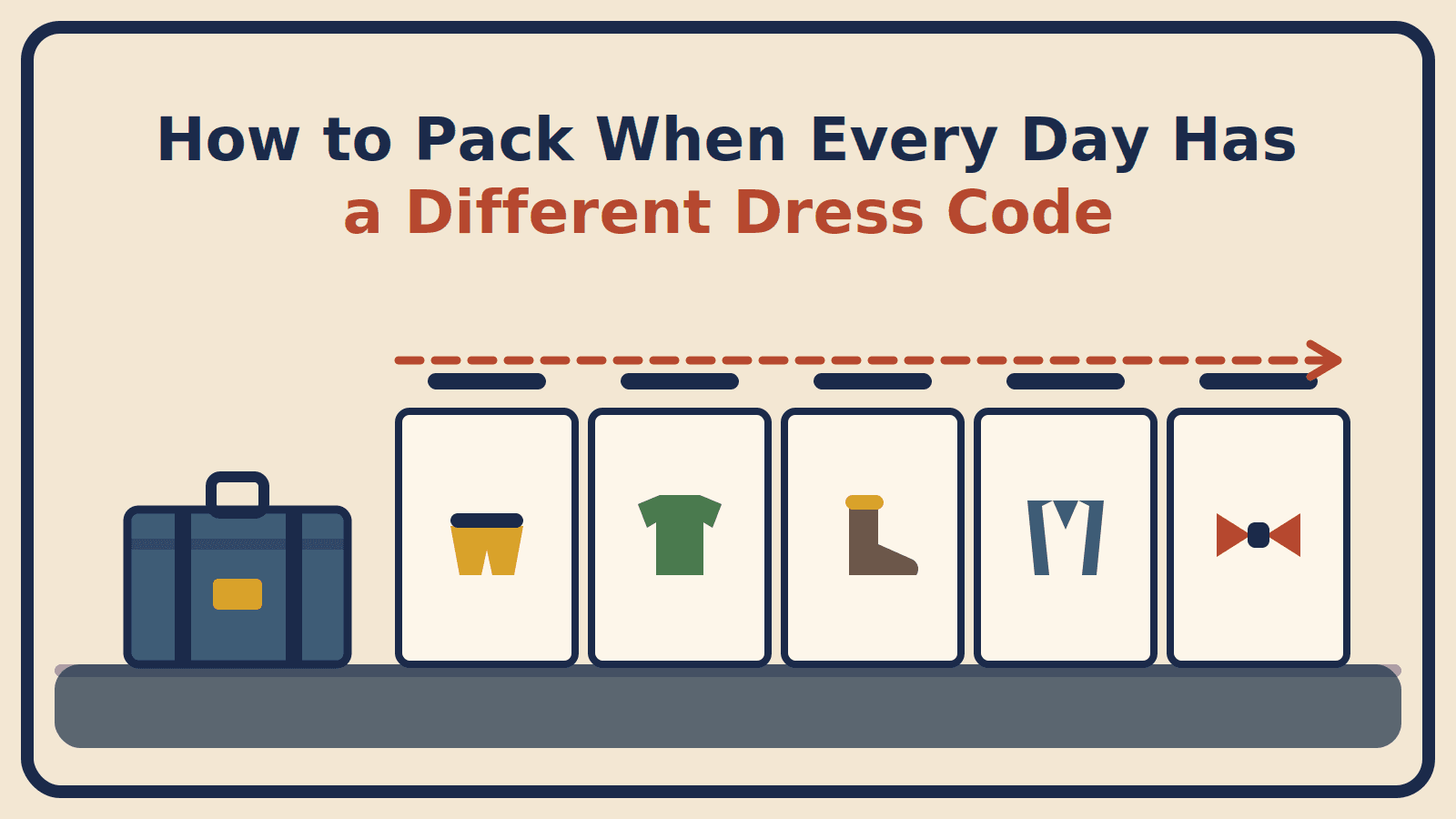
How to Pack for a Trip Where Every Day Has a Different Dress Code
August 15, 2026 · 6 min read
Prefer us on GoogleFive dress codes in seven days feels like five wardrobes. It is not. The codes overlap far more than they look, and the fix is one neutral base that survives every register plus a small set of pieces that move it up and down. Build the bag around the strictest code first.
Quick Answer
- Get the actual schedule, since most events publish codes in advance
- List the codes, then find the one shared base that survives all of them
- Pack two or three neutral bases, not one outfit per code
- Add four or five accent pieces: a jacket, a tie or scarf, jewelry, a dressier shirt
- Build around the strictest code first, since it is the least substitutable
- Choose shoes that cover two registers each, so two pairs cover four
- Keep color discipline tight, since a shared palette is what makes recombining work
- Ship ahead or rent anything bulky, delicate or worn once
- Note which items repeat in photographs, if that matters to you
- Plan a laundry or steam point if the trip runs longer than four days
- Leave space for the outfit you will end up buying
Why this is a combinatorics problem, not a wardrobe problem
There is a version of this problem where you do not know what the codes mean, and the answer there is research. This is the other version: you know all the codes and the difficulty is fitting them into one bag. That makes it arithmetic rather than uncertainty.
The arithmetic is friendlier than it looks. Five codes do not require five outfits, because most adjacent codes differ by one or two items rather than by everything. The gap between smart casual and cocktail is usually a jacket, a shoe and an accessory. The gap between resort casual and smart casual is often just the shoe. Once you see the codes as a ladder rather than a list, the packing problem collapses.
So the method is: find the neutral base that survives the widest span of the ladder, pack two or three of them, and then pack the small pieces that move a base up or down a rung. A dark pant or plain skirt with plain tops sits comfortably in the middle, and a jacket lifts it while a casual shoe drops it.
Build around the strictest code first, because it is the least substitutable item on the list. Nothing improvises into black tie, whereas almost anything improvises into casual. Pack that item, then fit the rest around what space remains. If the formal piece is bulky, delicate or worn exactly once, that is the strongest candidate for shipping ahead or renting at the destination rather than letting it distort the whole bag.
Two constraints deserve attention. Color discipline matters more here than on a normal trip, since recombining only works if everything shares a palette. And shoes are the real bottleneck, because they are the bulkiest register-changing item, so aim for pairs that each cover two rungs of the ladder. Our guide to double-duty outfit packing works through the piece-level version of this in more detail.
One human note: if photographs matter to you, and at a wedding week they often do, track which base appears on which day rather than pretending it will not be noticed. Changing the accent pieces is usually enough.
Common Mistakes
People pack an outfit per code. In practice the codes overlap, because adjacent registers usually differ by one or two items rather than by a whole outfit.
People build around the casual days. In practice you should build around the strictest code, because casual improvises and formal does not.
People pack pieces that do not share a palette. In practice recombining then fails, because a base only works across registers if the accents match it.
People bring a pair of shoes per code. In practice shoes are the bulkiest item to duplicate, so each pair should cover two registers.
People guess the codes from the invitation. In practice the schedule is usually available, because organizers and cruise lines publish codes ahead of time.
The codes are usually published, which is what makes this solvable
The reason a five-code trip is tractable is that you rarely have to guess. Cruise lines are the clearest example of an industry that formalizes this. Cunard states that guests are invited to a Gala Evening at least once on every voyage of three nights or more, and that the dress code is revealed in advance of sailing so you can pack accordingly. That is the whole principle: the information exists before you pack.
The frequency scales with trip length, which is exactly the kind of detail that changes what goes in the bag. Reporting on Cunard's 2026 season describes a 14-night sailing as typically including two or three Gala Evenings, against roughly one on a seven-night sailing, with the rest of the evenings at a "smart attire" level and no daytime code at all. Royal Caribbean's dressy nights are described as scaling similarly with sailing length.
Two caveats worth carrying. The published figures vary between sources and are stated at the operator's discretion, so treat any count as indicative and check your own booking. And the industry is not uniform: some lines have no formal nights at all, so a trip you assume carries a black-tie requirement may carry none. Cunard's own Gala Evenings page is the right place to check that specific case rather than a summary.
The transferable move is simple. Before you pack for any multi-code trip, ask the organizer, the venue or the operator for the per-day schedule rather than the headline description. A wedding party usually knows whether the welcome drinks are garden casual or cocktail. A conference usually knows whether the gala is black tie or dark suit. Getting that list turns an anxious guessing exercise into a straightforward sorting one.
A trip where one bag has to cover a pool day, a hike, a smart dinner and a black-tie evening is a genuine constraint problem rather than a long packing list. That kind of overlap is what JetKit is built to reason through, so what you pack covers every day rather than just the ones you thought about first.
Frequently Asked Questions
How do I pack for a trip with a different dress code every day?
Do not pack an outfit per code. Pick one neutral base that survives every register, then add a small number of pieces that shift it up or down: a jacket, a scarf or tie, a different shirt, one dressier shoe. Five codes usually resolve into two or three base outfits plus four or five accents.
What's the difference between packing for one unknown dress code and several known ones?
An unknown code is an information problem where you research, then hedge. Several known codes is a combinatorics problem where you already have the answers and the difficulty is fitting them in one bag. This post covers the second case, where the constraint is space rather than uncertainty.
How many outfits do I actually need for a week with five dress codes?
Usually far fewer than five. Two or three neutral bases plus four or five accent pieces will cover a week, because the codes overlap more than they appear to. Most of the difference between smart casual and cocktail is a jacket, a shoe and one accessory rather than a whole change of clothes.
Which item should I plan the whole bag around?
The strictest code on the itinerary, usually the most formal one. That item is the least substitutable, so it goes in first and everything else fits around it. If the formal piece is bulky or delicate, consider shipping it ahead or renting at the destination rather than distorting the entire suitcase.
Do cruise and event dress codes get published in advance?
Usually yes, and that is what makes this solvable. Cunard, for example, tells guests the dress code in advance of sailing so they can pack accordingly. Wedding parties, conferences and corporate events increasingly publish per-event codes too. Ask for the schedule rather than guessing from the invitation.
Related
More in Building a Travel Wardrobe.