How to Pack for a Business Trip Where You're Meeting the Team in Person for the First Time
August 14, 2026 · 5 min read
Prefer us on GoogleMeeting a remote team in person inverts the usual business-trip priorities. The professional stakes are lower, the social stakes are higher, and your colleagues have only ever seen you framed from the chest up. Pack for comfort and continuity rather than for looking impressive.
Quick Answer
- Dress at the team's level, not a level above it
- Keep visual continuity with how you appear on video, so you are easy to place
- Comfortable shoes above everything else, since these days run long and involve walking
- A layer for over-cooled meeting rooms and a warmer one for evenings
- One evening option for a team dinner, still casual rather than formal
- Something you can move in, since offsites add unplanned activities
- Enough day clothes for a repeatable base, not several distinct looks
- Anything you have promised to bring in person: a book, a gift, a hard drive
- A small notebook, since you will meet more people than you can retain
- Charging cables and adapters for a room that will not be set up for you
- Leave the formal wardrobe at home unless the schedule explicitly requires it
Why comfort beats polish here
Most business-trip advice is written for persuasion: a client, an investor, a stage. A first in-person meeting with your own team is a different task. These people already know your work. What they do not have is a physical sense of you, which is a social gap rather than a professional one.
That reframes the goal. You are not trying to look more impressive than your reputation, you are trying to be easy to be around for two or three days. Overdressing relative to the team creates distance and signals that you have misjudged the event. Underdressing rarely matters as much as people fear, because the room is populated by colleagues rather than evaluators.
There is a specific and useful move available: visual continuity. Your team has watched you in the same frame for months, often in a recognisable color, style or silhouette. Turning up looking recognisably like that person makes you easier to place in a crowded room and quietly reinforces that the person on the calls and the person in the room are the same. It is a small thing that does real work on day one.
The endurance question matters more than at a normal meeting too. Offsites tend to run longer than a work day, add meals and evenings, and frequently include an activity nobody warned you about, so comfortable shoes and something you can move in earn their space over a second smart outfit. Rooms are also often over-air-conditioned while evenings run cool, which makes a light layer one of the most-used items in the bag.
The general principle here, dressing to match a room rather than to stand out in it, is worked through in more depth in our guide to blending in rather than standing out, and it applies unusually cleanly to a first team meeting.
One practical addition: pack a small notebook. You will meet more people in two days than you can reliably remember, and writing down names and details is more useful than any garment in the bag.
Common Mistakes
People dress up to make an impression. In practice it creates distance, because the team reads formality as a signal that you have misread the event.
People pack for meetings only. In practice offsites add meals, evenings and unplanned activities, because the point of the trip is time together rather than an agenda.
People underestimate the walking. In practice these days involve moving between venues and standing for long stretches, because the schedule is built around gathering rather than sitting.
People bring several distinct outfits. In practice a repeatable base plus one evening option covers it, because nobody is auditing your wardrobe across three days.
People forget the layer. In practice meeting rooms run cold and evenings run cool, because venues are cooled for full rooms and offsites often end outdoors.
Half of you is new information
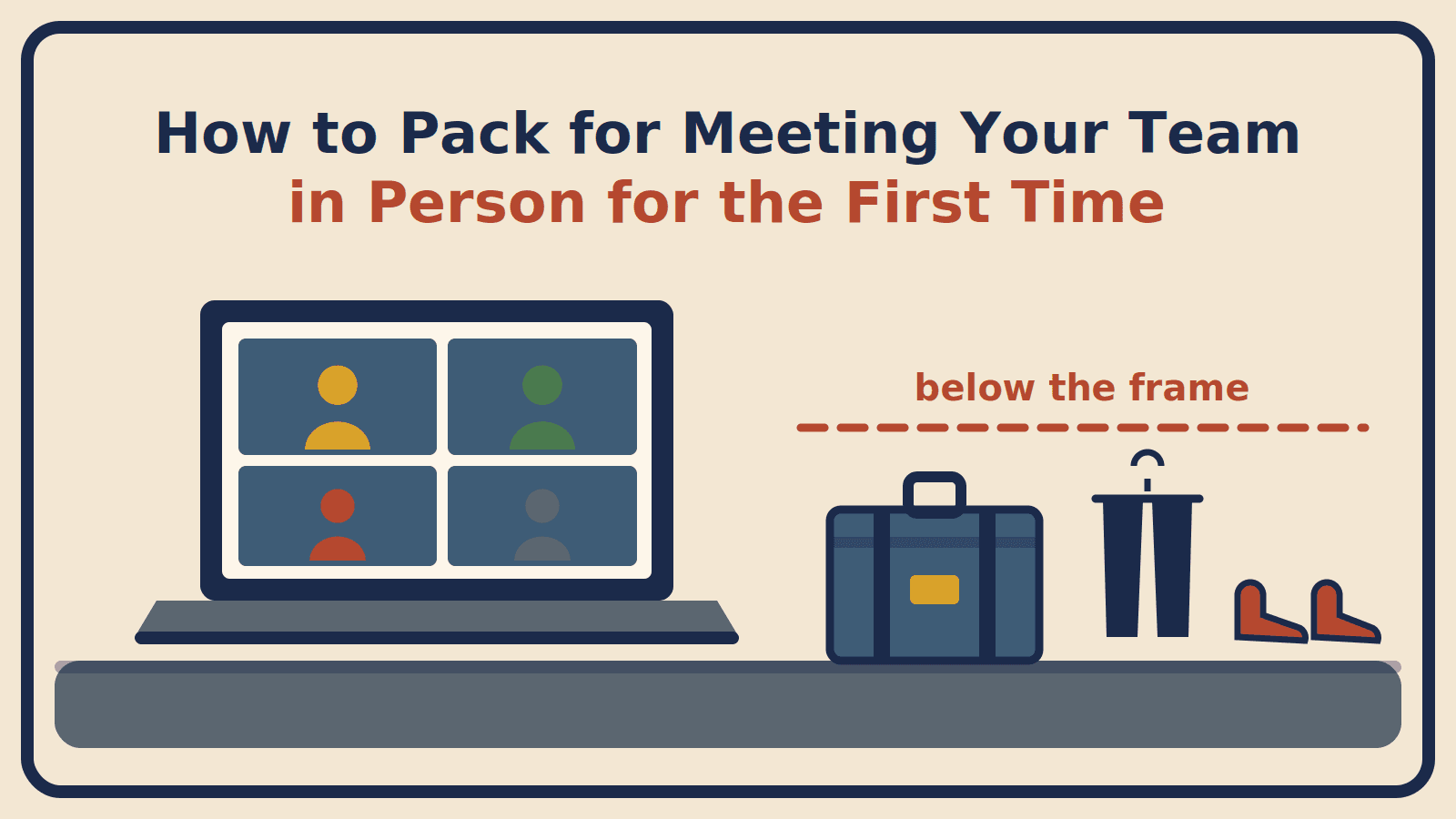
There is a reason a first in-person meeting feels stranger than it should. Video shows a very particular slice of a person: a face at close range, framed from roughly the chest up, in their own lighting, usually seated and largely still.
The most cited academic work on how video differs from being in a room is Jeremy Bailenson's 2021 paper in Technology, Mind, and Behavior, from Stanford's Virtual Human Interaction Lab. He identifies four features of videoconferencing that have psychological consequences: excessive close-up eye gaze, cognitive load from producing and interpreting nonverbal cues, increased self-evaluation from constantly seeing yourself, and constraints on physical mobility.
An honest caveat, and one Bailenson makes himself: he cautions that readers should treat his claims as arguments rather than as established scientific findings, since they draw on existing theory but had not yet been directly tested in that context. Take it as a well-argued account of how the medium differs, not as proof of what it does to first impressions.
Even at that level, the packing consequence is clear. Height, build, posture, how you move, what you wear below the chest, and what your shoes look like are all genuinely new information to your colleagues, and none of it was under discussion before. That is not a reason to overthink your outfit. It is a reason to make sure the parts nobody has seen are comfortable, because you will be standing, walking and sitting in them for far longer than a video call, and to keep the parts they have seen recognisable.
A trip where one bag has to cover meetings, a team dinner, an activity nobody mentioned and three days of being physically present with people who only know your face is a genuine constraint problem. That kind of overlap is what JetKit is built to reason through, so what you pack matches the trip you are actually taking.
Frequently Asked Questions
What should I wear to meet my remote team in person for the first time?
Wear something recognisably continuous with how you appear on video, then dress at the level the team actually dresses rather than a level above. If you always appear in a particular color or style on calls, keeping that thread makes you easier to place in a crowded room. Comfort matters more than polish here.
How is this different from a normal business trip?
The professional stakes are usually lower and the social stakes are higher. You are not persuading a client, you are becoming a real person to people who have only seen you framed from the chest up. That shifts the priority from looking impressive to being comfortable, present and easy to recognize.
Should I dress up more than usual to make a good impression?
Usually not. Overdressing relative to the team reads as distance rather than effort, and these events tend to run long with meals, activities and late evenings where formal clothing becomes a liability. Aim to land at the team's own level, then adjust once you have seen the room on day one.
What do people forget to pack for a team offsite?
Comfortable shoes, a layer for over-air-conditioned meeting rooms, and something for an unplanned social activity. Offsites usually add an evening out, a walk, or an activity nobody mentioned in advance, and the schedule tends to be longer and more physical than a normal work day.
How much should I pack for a multi-day team offsite?
Less than for a client trip, but with more variety in register. You need day clothes, one evening option, something you can move in, and a warm layer, rather than several formal outfits. Most offsites are two or three days, so a carry-on with a repeatable base handles it comfortably.
Related
More in Business Travel Packing.
- How to Pack for a Business Trip Squeezed Between Two Personal Commitments
- How to Pack for a Business Trip Where You'll Be Hosting, Not Just Attending
- How to Pack for a Business Trip With a Dress Code You've Never Encountered Before
- How to Pack for a Business Trip Where the Itinerary Isn't Finalized Yet
- How to Pack for a Business Trip With Back-to-Back Flights and No Hotel in Between