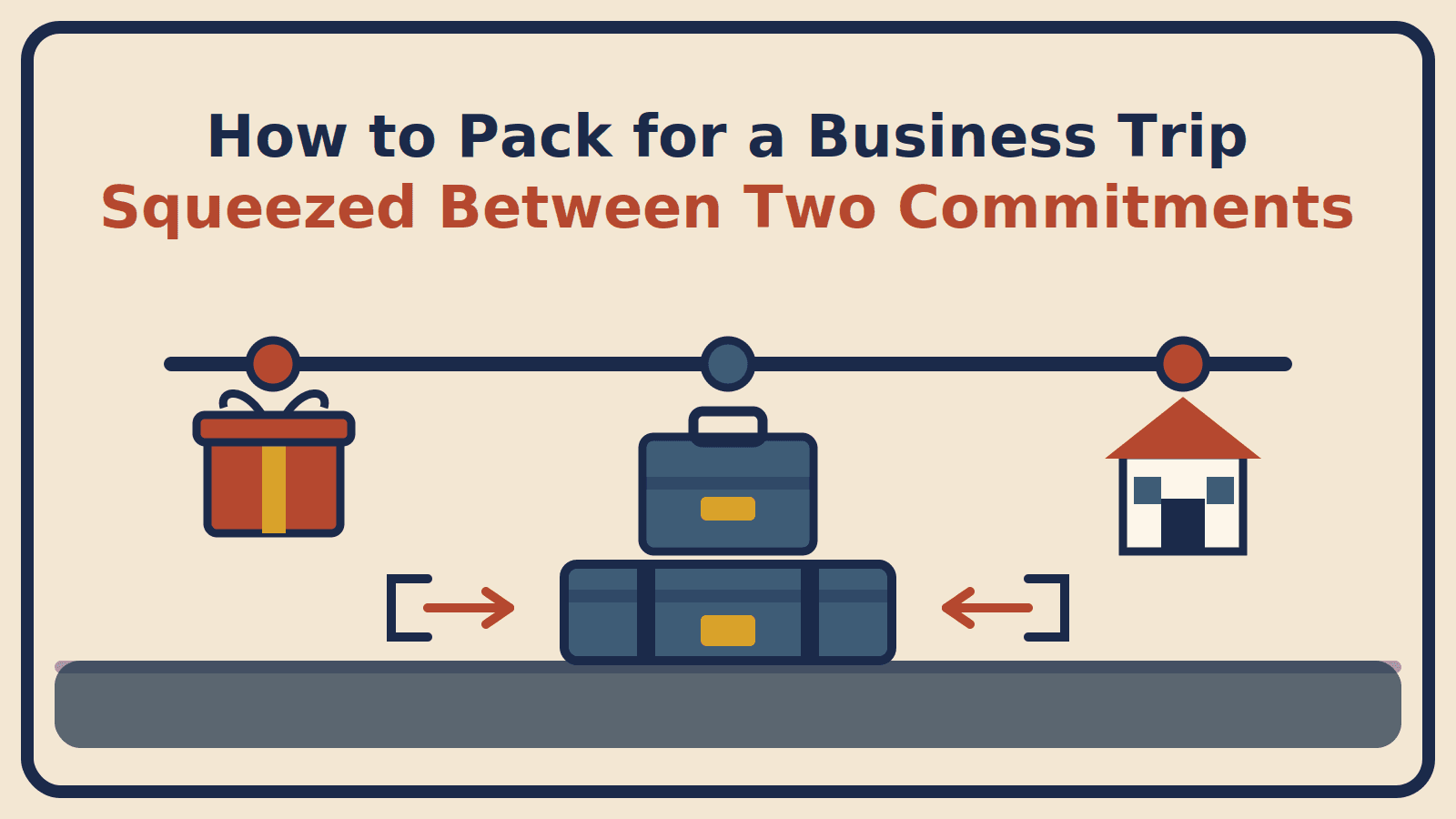
How to Pack for a Business Trip Squeezed Between Two Personal Commitments
August 14, 2026 · 7 min read
Prefer us on GoogleA work trip wedged between two personal commitments is not three trips. It is one bag with no chance to reset, serving three different registers. The way through is to pack the inflexible legs first, because the business portion is nearly always the one with the most give.
Quick Answer
- Identify the least flexible leg first, usually the personal one with a fixed dress code
- Pack that leg properly, then build the work portion from what is left over
- Choose one neutral base you can re-wear across all three legs
- Let distinctive pieces, not whole outfits, do the register-changing
- Pick shoes that work in at least two of the three settings
- Plan a laundry point roughly two-thirds of the way through
- Prefer quick-drying fabrics, since nothing gets a rest day
- Consider shipping one bulky or delicate item ahead, or home afterward
- Keep business and personal bookings clearly separated for expenses
- Carry anything irreplaceable, including gifts and event clothing
- Leave space for what the personal legs add: gifts, leftovers, photos, handovers
Why you pack backwards here
The instinct is to pack in trip order: personal, then work, then personal. That produces a bag built around the first thing you will wear rather than the thing with the least room to move.
The better order is by flexibility, not by chronology. Personal commitments tend to come with fixed requirements that are not yours to negotiate. A wedding has a dress code. A funeral has one. A christening, a milestone birthday, a family portrait all have expectations attached, often set by someone else. Work, by contrast, usually tolerates a range: a neutral base with a jacket clears most meetings, and you can adjust upward or downward on the day.
So pack the constrained legs first and let the business portion absorb whatever compromise remains. If the wedding needs a specific outfit and specific shoes, those go in. The work leg then gets built from what fits around them, not the other way around.
It helps to do this against the calendar rather than the day count. Every event on the run, a client meeting, a solo dinner before the meetings start, a family lunch after they end, tells you something specific to pack for, and a personal day deserves its own planned outfit the same way a client meeting does. Counting days instead of events is how a bag ends up over-packed for formality on days that never needed it and short on the personal stretch that quietly got planned last.
The second structural fact is that there is no reset point. A normal business trip ends at home, where you unpack, wash everything and start again. Here you do not get that, so every item has to last the entire run. Quick-drying fabrics matter more than usual, a laundry point roughly two-thirds of the way through is worth planning in advance rather than improvising, and anything that can only be worn once is expensive in space.
The third is that the register changes but the base does not have to. One neutral pant or skirt worn under a different top reads as a different outfit in each setting, and one jacket ties the work leg together. Let the distinctive pieces do the switching, since a tie, a scarf, a different shirt or a piece of jewelry weighs almost nothing while a second full outfit weighs a great deal. This is the same logic behind our guide to packing for a multi-purpose work and vacation trip, which works through the shared-base approach in more detail.
One item deserves special handling. If a leg needs something bulky, delicate or single-use, a suit carrier, a formal dress, a gift, consider taking it out of the bag entirely by shipping it ahead to the hotel or to family, or sending it home afterward. That converts your worst packing problem into a shipping cost.
One consequence of that order is easy to miss. The usual advice to keep formal wear on top, last in and first out, assumes the formal wardrobe gets worn early. When the personal leg comes first and the work stretch sits in the middle, that structured piece has to survive being buried under casual clothes for longer before its turn arrives, so garment-bag protection or an inside-out fold is worth taking more seriously here, not less, since it absorbs more transit time before it gets worn.
Common Mistakes
People pack in trip order. In practice you should pack by flexibility, because the constrained legs decide what space the work leg gets.
People plan for a reset that never comes. In practice everything has to survive the full run, because there is no stop at home in the middle to wash and repack.
People pack three separate wardrobes. In practice a shared neutral base plus distinctive pieces covers all three, because register is signalled by details rather than by whole outfits.
People carry a single-use item the whole way. In practice shipping it ahead or home is often cheaper in space and stress, because one bulky garment can distort an entire bag.
People blend the bookings. In practice keeping business and personal reservations separate saves an expenses argument later, because the boundary is much harder to reconstruct after the fact.
Blended trips are common, but the numbers are messier than they look
Trips that mix business and personal legs are now normal rather than unusual, which is why hotels, airlines and employers all have language for it. The most frequently cited figure comes from GBTA's 2025 workplace mobility research, reported as 60 percent of US managed business trips including at least one blended day, up from 43 percent in 2019, with an average extension of about 2.3 days.
It is worth being honest about the quality of these statistics, because they get recycled heavily. Across published roundups the same phenomenon is reported as 70 percent, 84 percent and 89 percent of travelers wanting to extend a trip, and one aggregator puts millennials at 44 percent while another puts them at 65 percent, sometimes citing overlapping sources. Those cannot all describe the same thing, and most trace back to different survey questions rather than different realities. Treat any single figure as directional.
The one number with a practical consequence for packing and booking is more durable: most travelers pay for the personal portion themselves, commonly reported at around 71 percent, with a meaningful minority expensing personal incidentals in breach of policy. That matters here because it makes the booking split a real task rather than an afterthought. Separate the reservations, keep the business nights clean, and you avoid both an awkward expenses conversation and the temptation to blur the line.
It also has a packing consequence worth naming. If the personal legs are on your own money, the cost of solving a packing problem locally, a shirt bought near the venue, a bag checked one way, a garment shipped ahead, comes out of the same pocket. That is an argument for deciding those trade-offs deliberately before you leave rather than under pressure at 7am in a hotel room.
A trip where one bag has to cover a wedding, three days of meetings and a family weekend, with no stop at home in between, is a genuine constraint problem rather than a long weekend. That kind of overlap is what JetKit is built to reason through, so what you pack matches all three parts of the trip rather than just the one you thought about first.
Frequently Asked Questions
How do I pack for a business trip sandwiched between personal events?
Start from the least flexible leg. Personal commitments usually have fixed dress requirements you cannot negotiate, so pack those first and build the work leg around what is left. The business portion is almost always the part with the most give, since a jacket and neutral base can be dressed up or down.
What if I can't go home between the events?
Then treat it as one continuous trip with three registers rather than three trips. There is no reset point, so every item has to survive the whole run. That means quick-drying fabrics, a laundry plan roughly two-thirds of the way through, and shoes chosen to work in more than one setting.
Should I plan personal days the same way I plan business days when packing?
Yes. A leisure day before the business portion starts deserves its own planned outfit the same way a client meeting does, not a vague assumption that whatever's left over will work.
Does packing order matter for a trip where the business days aren't first?
Yes, more than on a standard business trip. If personal days come first and the business stretch sits in the middle, the formal pieces have to survive being buried under casual clothes for longer before their turn comes, which makes garment-bag protection or an inside-out fold worth taking more seriously, not less.
Should I ship clothes ahead if the trip is too long for one bag?
It can be worth it when one leg needs bulky or delicate items you will not use otherwise. Shipping a garment ahead to the hotel or to family, or sending things home afterward, removes the worst item from the bag. Weigh the cost against a checked bag fee and the risk of it arriving late.
Who pays for the personal parts of a blended trip?
Usually you do. Industry survey data suggests most travelers pay for the leisure portion themselves, and expensing personal nights is a common policy violation. Keep the bookings clearly separated so the business leg is easy to expense and the personal legs are easy to defend.
What is the single most useful item in this situation?
A neutral base you can re-wear across all three legs, so that the distinctive pieces do the work of changing register. A plain dark pant or skirt worn under different tops, with one jacket, covers a rehearsal dinner, a client meeting and a family lunch with far less luggage than three separate outfits.
Related
More in Business Travel Packing.
- How to Pack for a Business Trip Where You'll Be Hosting, Not Just Attending
- How to Pack for a Business Trip With a Dress Code You've Never Encountered Before
- How to Pack for a Business Trip Where You're Meeting the Team in Person for the First Time
- How to Pack for a Business Trip Where the Itinerary Isn't Finalized Yet
- How to Pack for a Business Trip With Back-to-Back Flights and No Hotel in Between