How Does an AI Packing App Know the Weather at My Destination?
September 6, 2026 · 5 min read
Prefer us on GoogleAsk how a packing app knows your destination's weather and the assumption behind the question is that it looks up a forecast. Often it can't, because for a large share of trips the forecast doesn’t exist yet.
Quick Answer
- Inside about ten days, apps can use a real forecast
- Beyond that there is no forecast, only climate averages for that place and season
- NOAA: five-day forecasts are ~90% accurate, seven-day ~80%, ten-day about a coin flip
- Temperature holds up far better than precipitation at any horizon
- Which means layers can follow the forecast; rain gear should be packed regardless
The horizon problem
Weather forecasting has a hard limit. The atmosphere is chaotic, so small errors in the starting conditions compound, and past a certain point the models diverge from reality no matter how much computing power you throw at them.
NOAA's published rule of thumb: a five-day forecast is accurate about 90% of the time, a seven-day forecast about 80%, and a ten-day or longer forecast is right roughly half the time. The drop-off isn’t gradual either. Accuracy falls sharply after day seven and becomes close to useless for specific predictions by day ten.
Now line that up against how people actually travel. Flights get booked weeks or months ahead. Packing thinking starts well before departure. For a trip booked in March for June, there is no forecast to consult and there won’t be one for months.
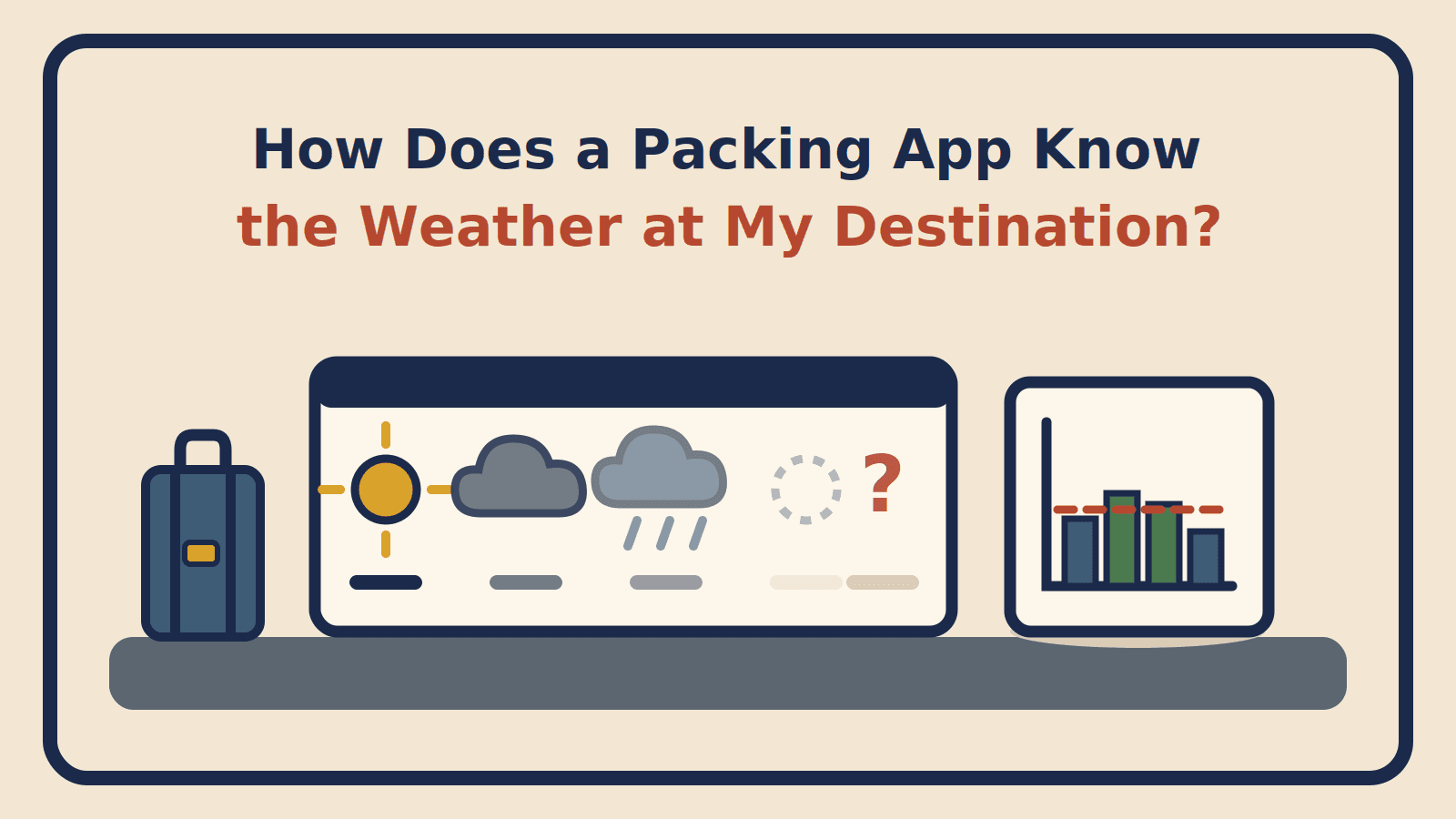
So any packing app is working from one of two fundamentally different inputs, and which one depends entirely on your dates:
Inside the horizon, a genuine forecast for your destination and travel dates, which is specific and reasonably trustworthy.
Outside the horizon, climate data: historical averages for that location and time of year. That tells you Reykjavik in October typically runs cold and wet, which is useful, but it is not a prediction about your particular week.
An app that presents both the same way is being misleading, even if unintentionally. "It'll be 62°F on the 14th" means something very different at four days out than at four months.
Temperature and rain degrade differently
This is the part that changes what you do, and it's underappreciated.
Temperature is driven by large, slow-moving air masses, which models handle comparatively well. At day seven, the average error on a high temperature is roughly 5 to 6°F. That's not nothing, the difference between 75°F and 80°F changes what you’d wear, but it keeps you in the right band.
Precipitation is different. Rain depends on moisture, localized lift and cloud processes that can shift by miles within hours. Those small-scale features are exactly what models resolve worst. One analysis puts it bluntly: the rain and shine icons past day five are closer to educated guesses than reliable predictions.
The packing consequence is clean. At a week out you can make your layering decisions from the forecast with reasonable confidence. You cannot make your rain-gear decision that way.
Which argues for treating a packable shell as standing equipment rather than a forecast-dependent choice. It weighs almost nothing, it compresses to the size of a water bottle, and the alternative is trusting a prediction the meteorology says isn’t trustworthy at that range.
What this means for the list you get
Three practical implications.
A list generated months out is a climate-based list. It should be broad rather than precise, and it should be revisited closer to departure. If an app gives you an oddly specific list for a trip in five months, that specificity is unearned.
Checking again inside five days is worth doing, because that's where forecast accuracy peaks. Usually the temperature-driven items don’t change much and the rain decision does.
Averages hide variance. A destination averaging 65°F in May might swing between 50°F and 80°F across a given week. Climate data gives you the middle, not the range, and packing for the middle leaves you exposed at both ends. This matters most in places with large day-to-night swings, which is covered in what to pack for 60-70°F weather.
How JetKit handles it
What's true regardless of the source is how the conditions get used. The destination's expected temperature range determines which garments in your closet are viable, and it feeds the quantity logic, since how many wears you get from a top depends partly on how warm it will be. Conditions constrain the candidate set rather than producing the list directly.
The honest limitation applies to every app in this category, including this one: no system can know about a cold snap that hasn’t formed yet, a local event you didn’t mention, or the fact that you personally run cold. Those remain yours to supply.
For the wider question of how accurate a generated list can be, see how accurate is an AI packing list. For choosing gear when the forecast itself is unreliable, see packing for unpredictable daily weather.
Frequently Asked Questions
How do packing apps get weather information?
Two different sources depending on how far out your trip is. Within about ten days they can use an actual forecast. Beyond that no useful forecast exists, so they fall back on climate data: historical averages for that location and time of year. The two are not equivalent and a good app should tell you which it's using.
How accurate are weather forecasts for packing?
NOAA's rule of thumb is that a five-day forecast is right about 90% of the time and a seven-day forecast about 80%. Ten days or longer is right roughly half the time. Accuracy falls sharply after day seven rather than gradually.
Can an app predict the weather for a trip months away?
No, and neither can anyone else. There is a hard physical limit to atmospheric predictability. What an app can do for a distant trip is use climate averages for that destination and season, which tells you the likely range rather than the actual conditions.
Is the temperature forecast more reliable than the rain forecast?
Yes, meaningfully. Temperature is driven by large, slow-moving air masses that models handle well, with an average error around 5 to 6°F at day seven. Precipitation depends on smaller-scale features that can shift by miles in hours, so rain predictions degrade much faster.
Should I repack after checking the forecast closer to departure?
Checking again inside five days is worthwhile, since that's where accuracy is highest. In practice the temperature-driven decisions rarely change much, while the rain decision often does, which is an argument for packing a shell regardless and treating it as insurance rather than a forecast-dependent choice.
Related
More in Packing for Weather.