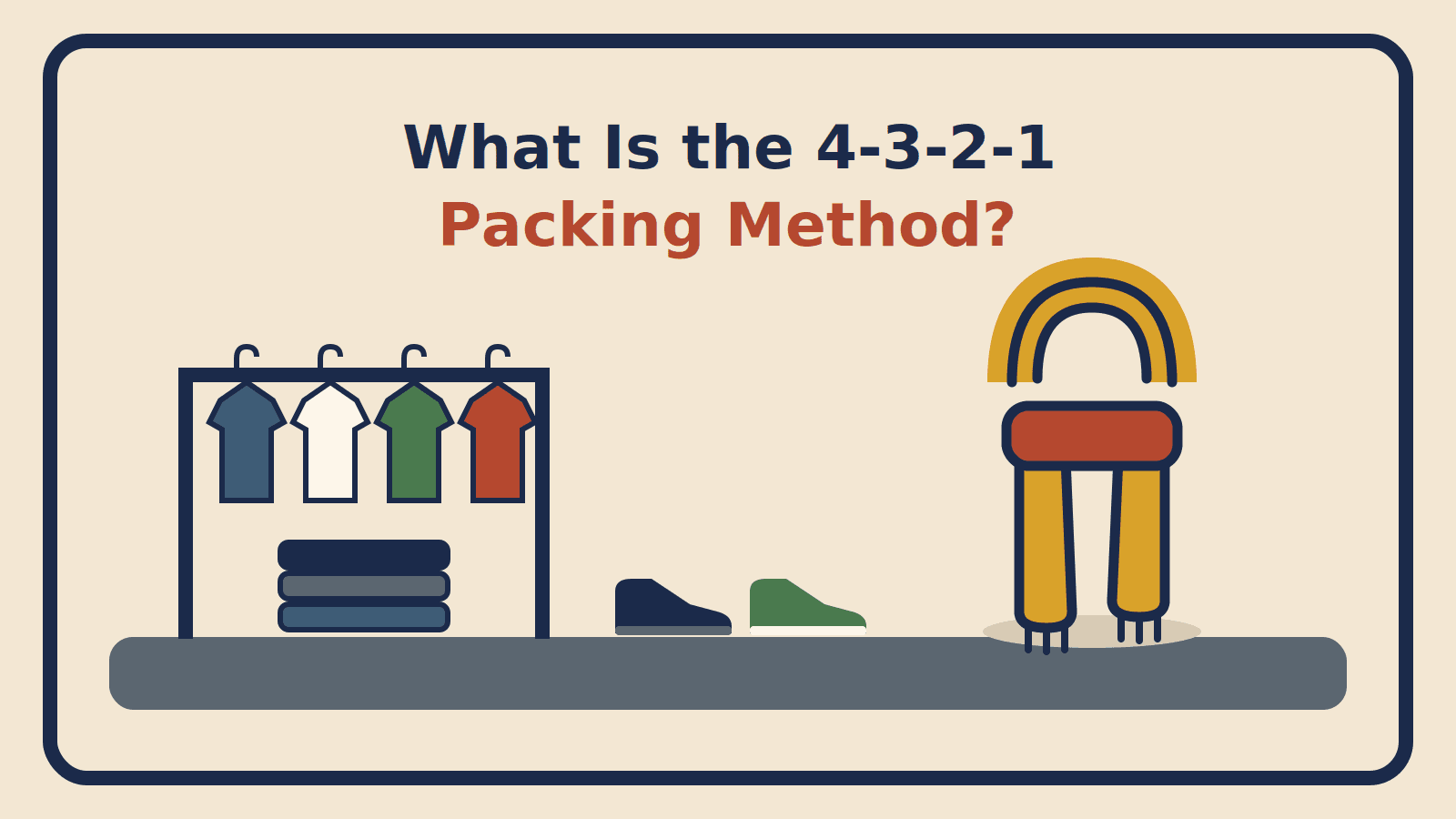
What Is the 4-3-2-1 Packing Method?
September 21, 2026 · 4 min read
Prefer us on GoogleThere is no established 4-3-2-1 packing method. Search for it and nearly every result describes 5-4-3-2-1, the formula popularized by blogger Geneva Vanderzeil. If you want something smaller, the documented options are 3-2-1 and 3-3-3, or you can run a four-category version, labeled here as an adaptation.
Quick Answer
- 4-3-2-1 is not a recognized packing method; the formula people usually mean is 5-4-3-2-1.
- 5-4-3-2-1: five tops, four bottoms, three pairs of shoes, two layers or dresses, one set of accessories.
- Documented short versions: 3-2-1 (three tops, two bottoms, one pair of shoes) and 3-3-3.
- A 4-3-2-1 adaptation (four tops, three bottoms, two shoes, one layer) gives twelve outfits.
- Every version depends on one coordinating palette.
Why You Won't Find a 4-3-2-1 Method
The 5-4-3-2-1 method has a clear origin. Blogger Geneva Vanderzeil introduced it, and it later found a much larger audience on TikTok. Nearly every packing formula circulating online is either that method or a documented variation of it.
A search for 4-3-2-1 turns up the five-number version almost every time. That pattern points to a misremembered name rather than a separate method. Descending number formulas are easy to garble, and dropping the first digit is the most natural slip.
The confusion is understandable, because the five-number version's own labels are unsettled. Published versions swap layers, dresses, and accessories between the last two categories, as covered in our breakdown of the 5-4-3-2-1 packing method. With that much variation, a four-number version feels plausible even though nobody established one.
The Documented Shorter Versions
If what you actually want is a smaller formula, two short versions are in real use.
The 3-2-1 version means three tops, two bottoms, and one pair of shoes. Luggage brand Carl Friedrik presents it as the ratio for quick trips, and it is essentially a weekend formula: six combinations, one pair of shoes worn the whole time.
The 3-3-3 version means three tops, three bottoms, and three pairs of shoes. It went viral on TikTok as a carry-on hack, and it produces nine realistic outfits. Our guide to the 3-3-3 packing method explains why the popular 27-outfit claim overstates it.
At the other end, some versions scale up to 6-5-4-3-2-1 for trips of two months or longer.
How to Run a 4-3-2-1 Adaptation
If a four-category list suits your trip, it works fine as long as you treat it as your own variation rather than an established rule. A sensible version looks like this:
- 4 tops. At least one should work as a slightly dressier option.
- 3 bottoms. One neutral pair that goes with everything, one casual, and one versatile piece.
- 2 pairs of shoes. One for walking, one for evenings. Wear the bulkier pair in transit.
- 1 layer. A sweater, jacket, or cardigan that works over every top.
Four tops and three bottoms produce twelve combinations, which covers a four to six day trip without repeating a pairing. That places it neatly between 3-3-3 and 5-4-3-2-1.
Why Every Version Works the Same Way
The numbers matter less than the rule underneath them. Every one of these formulas works by multiplication: a small number of tops and bottoms that all pair with each other yields far more outfits than the same number of standalone looks.
That only holds if every top works with every bottom. One piece that pairs with nothing else removes a whole row of combinations, which is why every version insists on one coordinating palette.
Common Mistakes
People assume 4-3-2-1 is an established method with a fixed definition. In practice no recognized source defines it, because the formula in circulation is 5-4-3-2-1.
People assume a smaller formula means a better-packed bag. In practice the right size depends on trip length and laundry access, because a formula that runs out of clean clothes mid-trip creates the scramble it was meant to prevent.
People assume the formula decides what to pack. In practice it only sets the count, because choosing which specific pieces coordinate is still up to you.
Where JetKit Fits
A packing formula tells you how many pieces to bring. JetKit handles the part a formula can't: it chooses the specific tops, bottoms, and shoes from the closet you already own and checks that they actually combine into complete outfits.
Frequently Asked Questions
Is there a 4-3-2-1 packing method?
Not as an established formula. Searches for it return articles about 5-4-3-2-1 instead, the packing method popularized by blogger Geneva Vanderzeil. If you have seen 4-3-2-1 mentioned, it is most likely a misremembering of the five-number version.
What is the 5-4-3-2-1 packing method?
The 5-4-3-2-1 packing method means packing five tops, four bottoms, three pairs of shoes, two layers or dresses, and one set of accessories, all from a coordinating palette. Sources disagree on the exact labels for the last two categories, but the descending ratio stays the same.
What is a shorter version of the 5-4-3-2-1 packing method?
The documented short versions are 3-2-1, which means three tops, two bottoms, and one pair of shoes, and 3-3-3, which means three tops, three bottoms, and three pairs of shoes. Both suit short trips of a few days with a carry-on.
Can I use a 4-3-2-1 packing list anyway?
Yes, as a personal adaptation. Four tops, three bottoms, two pairs of shoes, and one layer produce twelve top and bottom combinations, which works well for a four to six day trip. Just know it is a variation you are choosing, not a recognized method.
Related
More in Building a Travel Wardrobe.