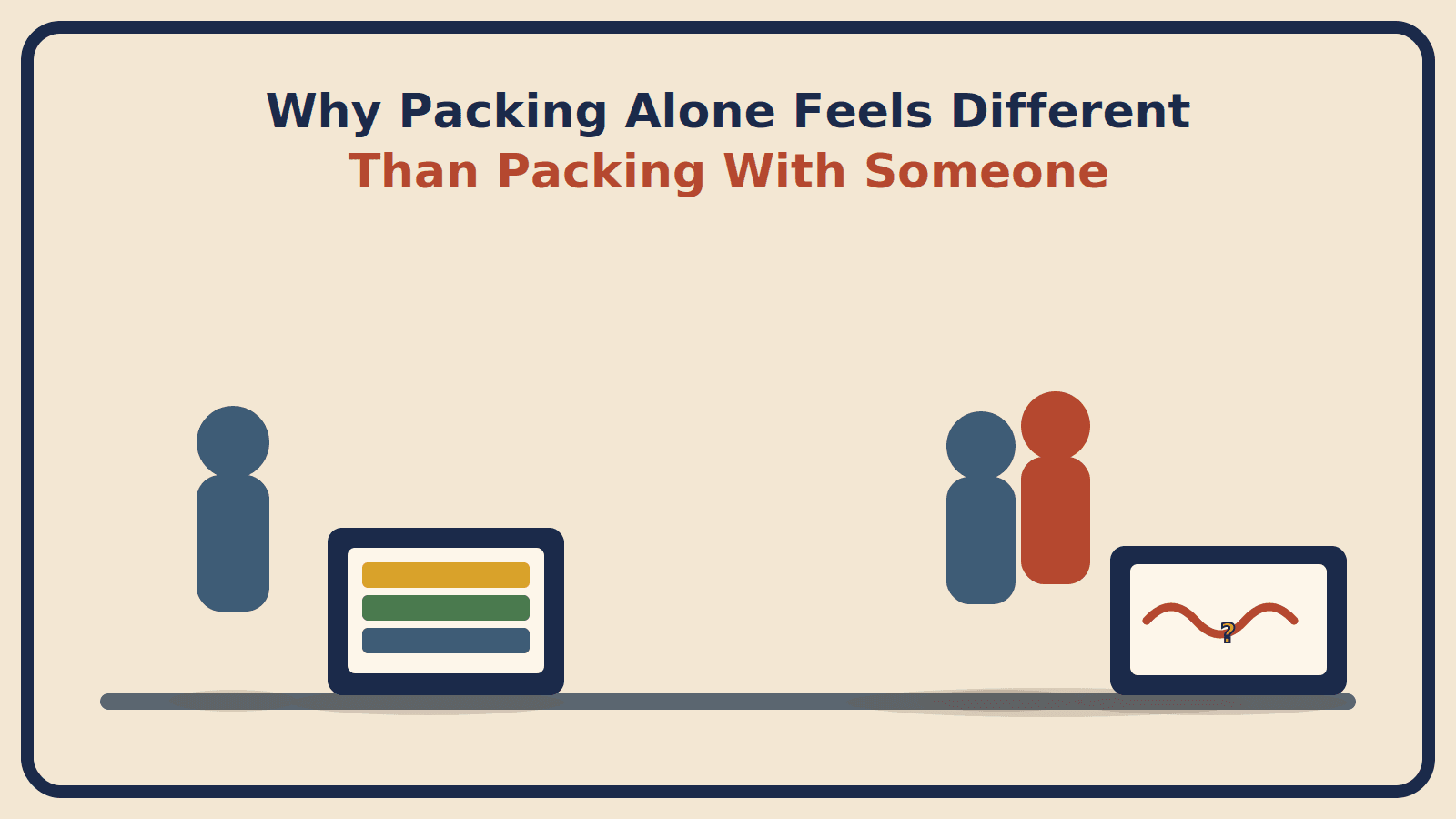
Why Packing Alone Feels Different Than Packing With Someone
September 25, 2026 · 4 min read
Prefer us on GooglePack the same trip twice, once alone and once with someone else nearby, and it will not feel like the same task. That is not in your head. Another person's presence changes how your brain approaches a decision, and which packing decisions get easier or harder depends on a pattern that has been studied for sixty years.
Quick Answer
- Another person's presence raises arousal, and arousal strengthens whichever response is most automatic for the task at hand
- Routine packing decisions get easier with company. Folding the way you always fold, grabbing your usual staples, these go faster and more smoothly with someone else around
- Genuinely uncertain decisions get worse with company. Ambiguous weather, an unfamiliar occasion, these are exactly the decisions arousal does not help with
- This is Robert Zajonc's social facilitation theory (1965), one of the most replicated findings in social psychology
- It is a different problem from splitting a suitcase or clashing style, which are about logistics and taste, not decision quality
Same Person, Same Room, Opposite Effect
Robert Zajonc's social facilitation theory answered a real paradox: sometimes having someone watch you work makes you better at it, and sometimes it makes you visibly worse, and both effects are completely real. The difference is not about the person watching. It is about the task.
The presence of another person raises physiological arousal, even when nothing about the situation feels tense. That arousal strengthens whatever response is most dominant, meaning most automatic, for whatever you are doing. On a simple or well-practiced task, the automatic response is usually the correct one, so arousal pushes performance up. On a complex or unfamiliar task, the automatic response is usually the wrong one, so the same arousal pushes performance down.
Packing is not one task. It is a mix of both kinds at once, which is exactly why it feels inconsistent depending on who is around.
The Split, Applied to a Suitcase
The staples are the well-practiced half. You have folded this way a hundred times, you know your own five reliable outfits, you know what always goes in the toiletry bag. These decisions barely require thought, which is precisely the condition under which social facilitation theory predicts company helps. Another person in the room, even just talking about something unrelated, tends to make this half go faster and feel easier.
The uncertain half is different. What do you actually need for weather that could break either way. What reads right for an occasion you have never dressed for before. Whether that one borderline item earns its space. These decisions have no automatic correct answer, which means they need the kind of unhurried, non-automatic thinking that arousal specifically interferes with. This is the half that gets worse with someone else around, not because they are distracting you on purpose, but because their presence alone is enough to push you toward a faster, more automatic call on a decision that needed the opposite.
This is a different problem from splitting a suitcase with someone, which is about dividing weight and space fairly. It has nothing to do with whose bag anything goes in. It is about what another person's presence does to the quality of your own decisions, and it would happen the same way even packing entirely separate bags in the same room.
What to Do With This
You cannot switch off arousal by knowing about it, and you should not try to avoid packing with people around altogether, since half of what packing involves genuinely benefits from the company. The more useful move is matching the setting to the decision.
Handle the routine half whenever it is convenient, with people around or not, since it barely matters either way. But when you hit a decision that genuinely has no obvious answer, the weather is a toss-up, the occasion is unfamiliar, try making that specific call somewhere quiet, even if it means stepping away from an otherwise social packing session for two minutes. The goal is not solitude for its own sake. It is giving the one kind of decision that needs unhurried thinking the actual conditions it needs.
Frequently Asked Questions
Why does packing feel different when someone else is in the room?
Because another person's presence raises physiological arousal, and arousal amplifies whatever response is most automatic for the task. Psychologist Robert Zajonc's social facilitation theory found this makes simple, well-practiced tasks go smoother with company and complex or unfamiliar tasks go worse under the same conditions.
Does packing with someone else make you pack faster or slower?
Both, depending on the decision. Routine parts of packing, folding the way you always fold, grabbing your usual staples, tend to go faster and smoother with someone else around. Genuinely uncertain decisions, like what to bring for unpredictable weather or an unfamiliar occasion, tend to go worse under the same conditions, because those are the decisions arousal does not help with.
What is social facilitation theory?
It is Robert Zajonc's 1965 theory explaining why the presence of others sometimes helps performance and sometimes hurts it. The presence of another person raises arousal, which strengthens the dominant response for a task. On simple tasks the dominant response is usually correct, so performance improves. On complex tasks the dominant response is usually wrong, so performance gets worse.
Is this the same issue as splitting a suitcase with a partner?
No. Splitting a bag is a logistics problem about weight and space, and clashing style is a separate aesthetic problem. This is about how another person's presence changes the quality of your own packing decisions in the moment, independent of whose bag anything goes in or whose taste wins.
Should I pack the hard decisions alone?
It is worth trying. If a decision genuinely has no obvious right answer, weather that could go either way, an occasion you are unsure about, making that call while alone removes the arousal that pushes you toward a fast, automatic answer rather than the considered one. Save the routine packing, the parts you could do without thinking, for whenever company happens to be around.
Related
More in The Psychology of Packing.
- How to Pack for a Trip When You Genuinely Don' t Know What You' ll Feel Like Wearing
- Why Does Packing Feel Harder Than It Should?
- Why Do I Forget Something on Every Trip?
- How to Pack for a Trip Where You Don't Trust Your Own Judgment Anymore
- How to Pack for a Trip When You Keep Changing Your Mind About What to Bring