How to Pack for a Business Trip Where First Impressions Matter More Than Usual
August 17, 2026 · 6 min read
Prefer us on GoogleWhen a first impression carries unusual weight, the temptation is to overthink the outfit. The bigger risk is different: an ordinary travel failure, a delayed bag, a spill, a crease, landing on the one day you cannot absorb it. Pack for the failure modes and the outfit takes care of itself.
Quick Answer
- Decide the outfit a week out, then stop revisiting it
- Carry it on, always, and never check the bag it is in
- Seal it in its own bag so nothing can leak or transfer onto it
- Duplicate the least replaceable item, usually the shirt or top
- Wear or carry anything that has to fit you specifically
- Pack a repair kit: stain pen, lint roller, spare buttons, safety pins, blister pads
- Steam or press on arrival, not on the morning
- Arrive with a buffer of hours, not minutes, so failures become errands
- Break in the shoes weeks before, never on the day
- Know what shops are near your hotel before you land
- Keep the backup sealed and untouched until you have confirmed the primary is fine
Why redundancy beats deliberation
Most advice for high-stakes trips is about what to wear. That question is usually already answered: dress at the level of the room, clean, fitted and unwrinkled. Beyond that, the marginal outfit decision is small compared with the marginal failure.
The failures are ordinary and well known. A bag arrives late. A coffee lands on a shirt at 30,000 feet. A jacket comes out of a bag with a set crease and there is no iron. Rain arrives with no coat. None of these are unusual, and on a normal trip they are absorbed without consequence because there is always tomorrow. On this trip there is not, which is what actually makes it different.
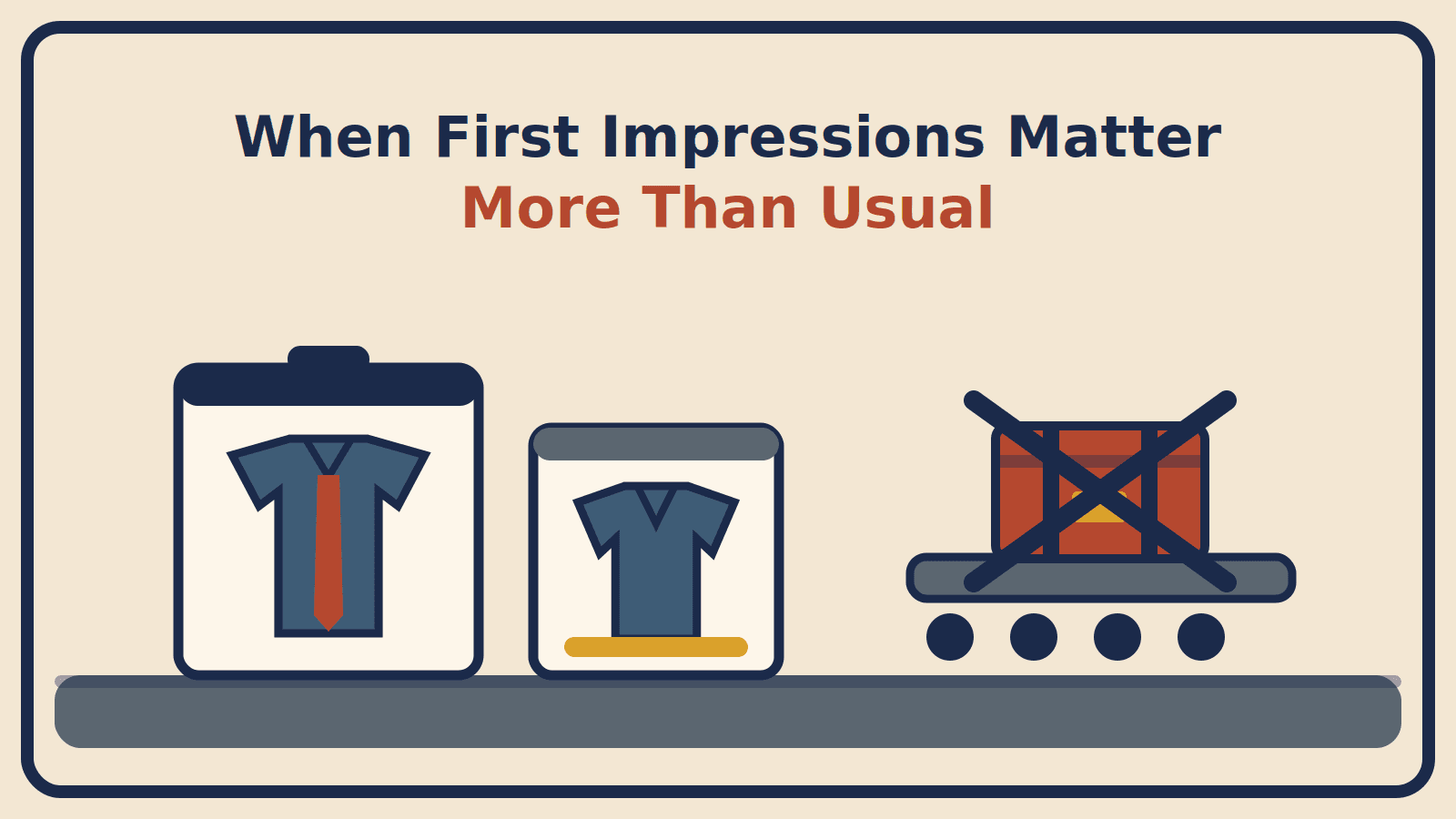
So the packing brief changes from selection to insurance. Carry the outfit rather than checking it. Seal it in its own bag so nothing can leak onto it. Duplicate the one item that cannot be replaced locally, which is almost always the shirt or top, since a spare weighs little and a spill is the most likely single failure. And put anything that must fit you specifically on your body or in the bag that never leaves your hand.
Timing is the other lever, and it is cheaper than gear. A buffer of a few hours converts most wardrobe failures from a crisis into an errand: a shirt can be pressed, a tie replaced, a shop visited. Arriving the night before does more for your appearance than anything you could buy. Press or steam on arrival rather than in the morning, when you have neither time nor patience.
One thing to leave alone: the impulse to buy something new for the occasion. New shoes are the classic mistake, since they blister on exactly the day you need to walk confidently. Our guide to looking sharp on arrival covers the mechanics of getting off a plane presentable in more depth.
Common Mistakes
People optimize the outfit. In practice condition matters more than choice, because a well-fitted clean garment outperforms an expensive creased one.
People check the bag with the outfit in it. In practice that outsources the most important item to a system you do not control, because you cannot influence whether it arrives.
People pack one of everything. In practice a spare shirt is cheap insurance, because a spill is the single most likely failure and the least fixable in a hotel room.
People buy new shoes for the occasion. In practice they cause blisters on the day, because footwear needs weeks of wear before it is trustworthy.
People arrive just in time. In practice a few hours of buffer converts a crisis into an errand, because most wardrobe failures are solvable with access to a shop or an iron.
Your bag probably arrives. Probably is the problem.
The reason not to check the outfit is not that airlines are bad at baggage. They have got substantially better, and the numbers show it.
SITA's 2026 Baggage IT Insights report found that mishandling rates fell 23 percent in 2025 to 4.9 bags per 1,000 passengers, with total volumes down 19 percent to about 24 million bags, both below pre-pandemic levels for the first time even as passenger numbers hit five billion. Long term, mishandling has fallen by close to three-quarters since 2007.
Four or five bags in a thousand is a very good rate, and for a holiday it is irrelevant. What makes it relevant here is the shape of the risk rather than its size. Transfers remain the largest single cause, at 39 percent of cases in 2025, so an itinerary with a connection carries meaningfully more exposure than a direct flight. Rates also vary sharply by region: the previous year's report put Asia-Pacific at 3.1 per 1,000, North America at 5.5 and Europe at 12.3, a fourfold spread. And while roughly two-thirds of delayed bags are returned within 48 hours, that leaves a third that are not, and 48 hours is already far too late when the meeting is tomorrow at nine.
Two honest notes. These are industry-wide averages, so your specific route, airline and connection matter more than the headline figure. And the trend is genuinely improving, so this is not an argument that checking a bag is reckless. It is an argument that a small, well-understood probability is worth eliminating entirely when the cost of it landing is high and the cost of avoiding it is one carry-on. SITA's report page has the current figures.
That is the whole logic of the trip. You are not trying to look better than usual. You are trying to remove the small chance of looking much worse.
A trip where one bag has to survive a connection, a spill, a crease and a compressed morning, with no room to recover from any of them, is a genuine constraint problem rather than a wardrobe question. That kind of overlap is what JetKit is built to reason through, so what you pack holds up on the day that matters.
Frequently Asked Questions
How should I pack for a high-stakes first meeting?
Pack for failure modes rather than for the look. Decide the outfit early, carry it on rather than checking it, seal it so nothing else can spill on it, and add a cheap backup for the one item that cannot be replaced locally. The outfit choice is usually the easy part.
Should I ever check a bag when the meeting is critical?
Not with the outfit in it. Mishandling rates are low overall but they are not zero, transfers cause the largest share, and roughly a third of delayed bags take more than 48 hours to come back. That timeline is fine for a holiday and useless when your meeting is tomorrow morning.
What's the single most useful thing to pack for a high-stakes trip?
A sealed backup of the least replaceable item, usually a shirt or top. Everything else can be bought, borrowed or improvised near most business districts. The piece that has to fit you specifically and match everything else is the one worth duplicating.
How early should I arrive for an important meeting?
Early enough to fix a problem, not just early enough to be on time. A buffer of a few hours lets you press a shirt, replace a spilled-on tie or find a shop. Arriving the night before turns most wardrobe failures from a crisis into an errand.
Does the outfit itself matter less than people think?
The choice matters less than the condition. Being appropriately dressed at the level of the room, in something clean, fitted and unwrinkled, does more work than an expensive garment worn creased. Spend the effort on fit, upkeep and redundancy rather than on buying something new for the occasion.
Related
More in Business Travel Packing.
- How to Pack for a Business Trip With Back-to-Back Flights and No Hotel in Between
- How to Pack for a Business Trip Where You'll Be Representing the Company at an Event
- How to Pack for a Business Trip With a Strict Per-Diem or Luggage Policy
- How to Pack for a Trip Where You'll Be Photographed for Work
- How to Pack for a Business Trip Squeezed Between Two Personal Commitments