What Executives Pack Differently Than Junior Employees on Business Trips
July 27, 2026 · 4 min read
Prefer us on GoogleThe baseline mechanics of business travel packing, a capsule wardrobe of neutral, mix-and-match pieces, rolling clothes to save space, a portable steamer for the inevitable wrinkle, apply the same way whether you're a first-year analyst or the CEO. What actually changes with seniority isn't the packing technique so much as the margin for error, the budget behind the gear, and how much of the trip's logistics someone else is handling.
Quick Answer
- Capsule wardrobe fundamentals (neutral colors, blazer, dress shirts) hold at every level
- Redundancy scales with seniority: a backup shirt, a better garment bag, a steamer as standard
- Luggage investment tracks trip frequency and stakes, not title itself
- Accessory expectations rise with how client-facing or senior the trip's purpose is
- Senior trips more often have logistics handled separately, freeing focus for wardrobe alone
Why the Fundamentals Don't Change With Title
The capsule wardrobe fundamentals hold at every level: neutral colors (black, navy, gray, white) that pair well together, two or three dress shirts, a blazer, a pair of dress pants, and a couple of ties or scarves for variety cover most formal business scenarios regardless of title. Comfortable, presentable casual pieces for downtime or after-hours events matter at every level too. Rolling clothes over folding, using packing cubes or a garment bag for anything prone to wrinkling, and wearing the bulkiest item (a blazer or coat) while traveling rather than packing it are universal space-savers, not seniority-dependent ones.
Where Redundancy Actually Changes
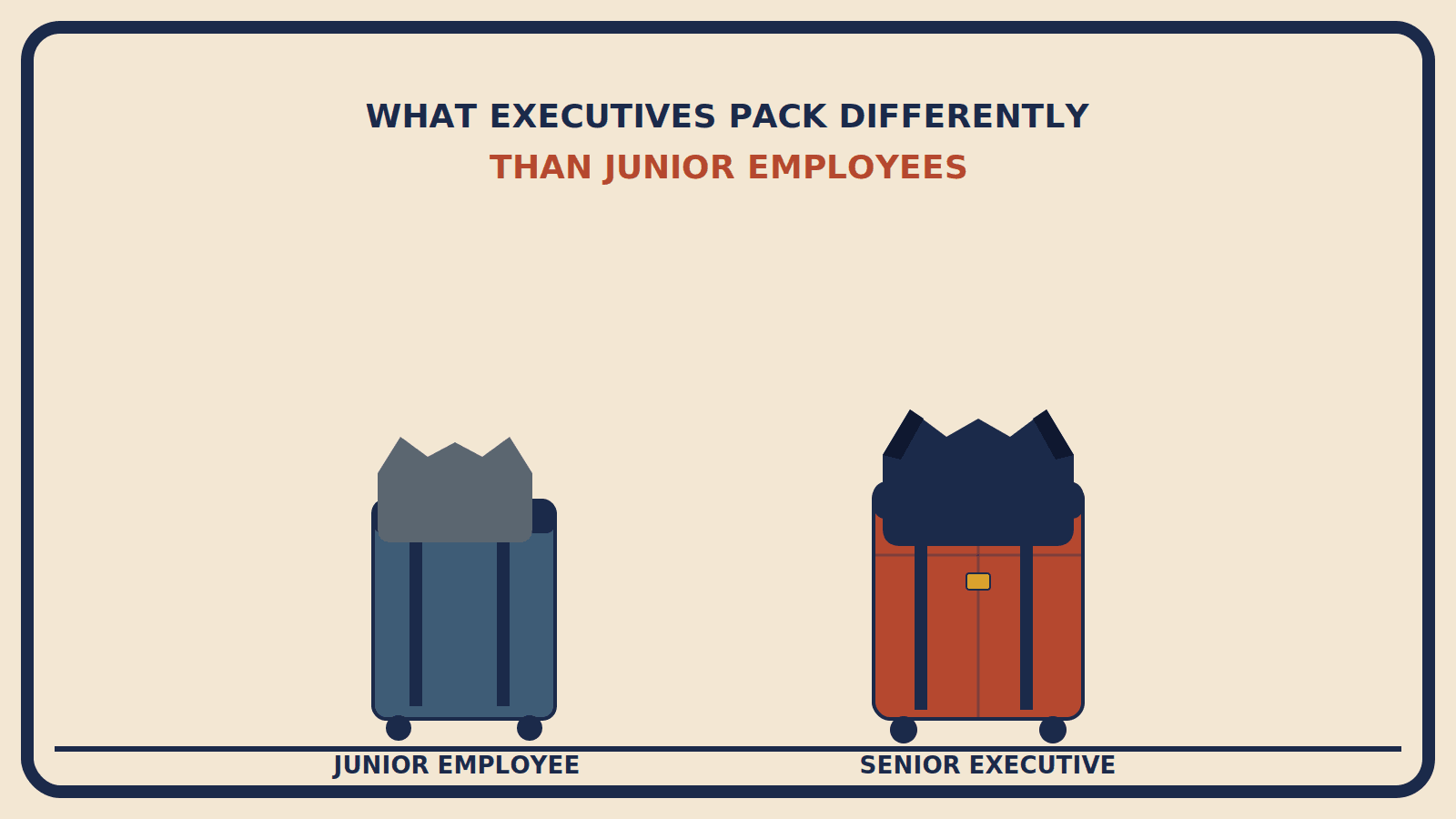
Where the real difference shows up is in the quality and redundancy built into the kit. A junior employee packing on a tight personal or modest expense budget is more likely to travel with one blazer, one pair of dress shoes, and accept some risk if something goes wrong, a wrinkle that doesn't fully release, a shoe that needs a quick polish. A more senior traveler with a larger expense allowance and more at stake in how they present tends to build in more redundancy: a backup shirt for an unexpectedly long day, a higher-quality garment bag that genuinely prevents wrinkles rather than just packing to minimize them, and premium wrinkle-release tools or a portable steamer treated as a given rather than a nice-to-have.
Luggage itself tends to track seniority too, less because of vanity and more because of trip volume and stakes. Someone traveling occasionally for work can reasonably get by with a budget carry-on and accept its limitations. Someone traveling weekly, representing the company in rooms where a scuffed bag or a broken zipper becomes a small but real distraction, tends to invest in more durable, better-performing luggage, not because the packing math changes, but because the cost of a bag failure is higher when it happens on the tenth trip of the quarter rather than the first.
Common Mistakes
People assume packing technique itself should change with seniority. In practice, rolling clothes, using packing cubes, and wearing the bulkiest item while traveling work the same way for a first-year analyst as for a CEO. What changes is the redundancy and quality layered on top, not the underlying method.
People assume accessories are purely a personal style choice unrelated to role. In practice, a watch, cufflinks, or jewelry that reads as a notch more polished tends to show up more consistently the more client-facing or senior the trip's purpose is, less because junior employees can't wear nice things and more because the accessory budget and the expectation both tend to rise together.
People assume expensive gear alone signals seniority. In practice, fit and condition matter more than price at every level. A junior employee in a well-fitting, cleanly-traveling blazer looks more put-together than someone in an ill-fitting expensive one.
This piece on deciding what jewelry to pack is worth a look for anyone navigating that particular judgment call, regardless of where they sit on the seniority ladder.
The Logistical Difference
The other real difference is logistical rather than physical: a senior executive's trip is more likely to have someone else, an assistant, a travel coordinator, handling itinerary logistics, which frees up packing decisions to focus purely on wardrobe and presentation rather than juggling bookings at the same time. A junior employee is more often doing both simultaneously, which is its own kind of packing pressure even when the actual clothing list looks nearly identical.
Frequently Asked Questions
Do executives and junior employees pack differently for business trips?
The baseline mechanics are the same: a capsule wardrobe of neutral, mix-and-match pieces, rolling clothes to save space, a portable steamer for wrinkles. What actually changes with seniority isn't the packing technique so much as the margin for error, the budget behind the gear, and how much of the trip's logistics someone else is handling.
What does every business traveler pack regardless of seniority?
Neutral colors (black, navy, gray, white) that pair well together, two or three dress shirts, a blazer, a pair of dress pants, and a couple of ties or scarves for variety cover most formal business scenarios regardless of title. Rolling clothes, packing cubes or a garment bag, and wearing the bulkiest item while traveling are universal space-savers too.
Why do senior travelers pack more redundancy than junior employees?
A junior employee on a tighter budget is more likely to travel with one blazer and one pair of dress shoes, accepting some risk if something goes wrong. A more senior traveler with a larger expense allowance and more at stake tends to build in backups: a spare shirt, a higher-quality garment bag, and a portable steamer treated as a given rather than a nice-to-have.
Does luggage quality track seniority?
Often, though less because of vanity and more because of trip volume and stakes. Someone traveling occasionally can reasonably get by with a budget carry-on. Someone traveling weekly, representing the company in client rooms, tends to invest in more durable luggage, since the cost of a bag failure is higher on the tenth trip of the quarter than the first.
Do junior employees need to buy expensive gear to look put-together?
No. A junior employee packing a well-fitting, cleanly-traveling blazer will look more put-together in a meeting than someone in an ill-fitting expensive one. Fit and condition matter more than price at every level.
Related
More in Business Travel Packing.
- How to Pack for a Business Trip With Limited Hotel Amenities
- How to Pack for a Trip With a Client Site Visit (Factory, Warehouse, Outdoor Settings)
- How to Build a "Go Bag" for Last-Minute Business Travel
- How to Pack for a Multi-Purpose Trip (Work + Vacation in One)
- How to Pack for a Business Trip Where You'll Be On Camera (Video Calls, Presentations)