Does an AI Packing App Work for International Trips?
September 7, 2026 · 5 min read
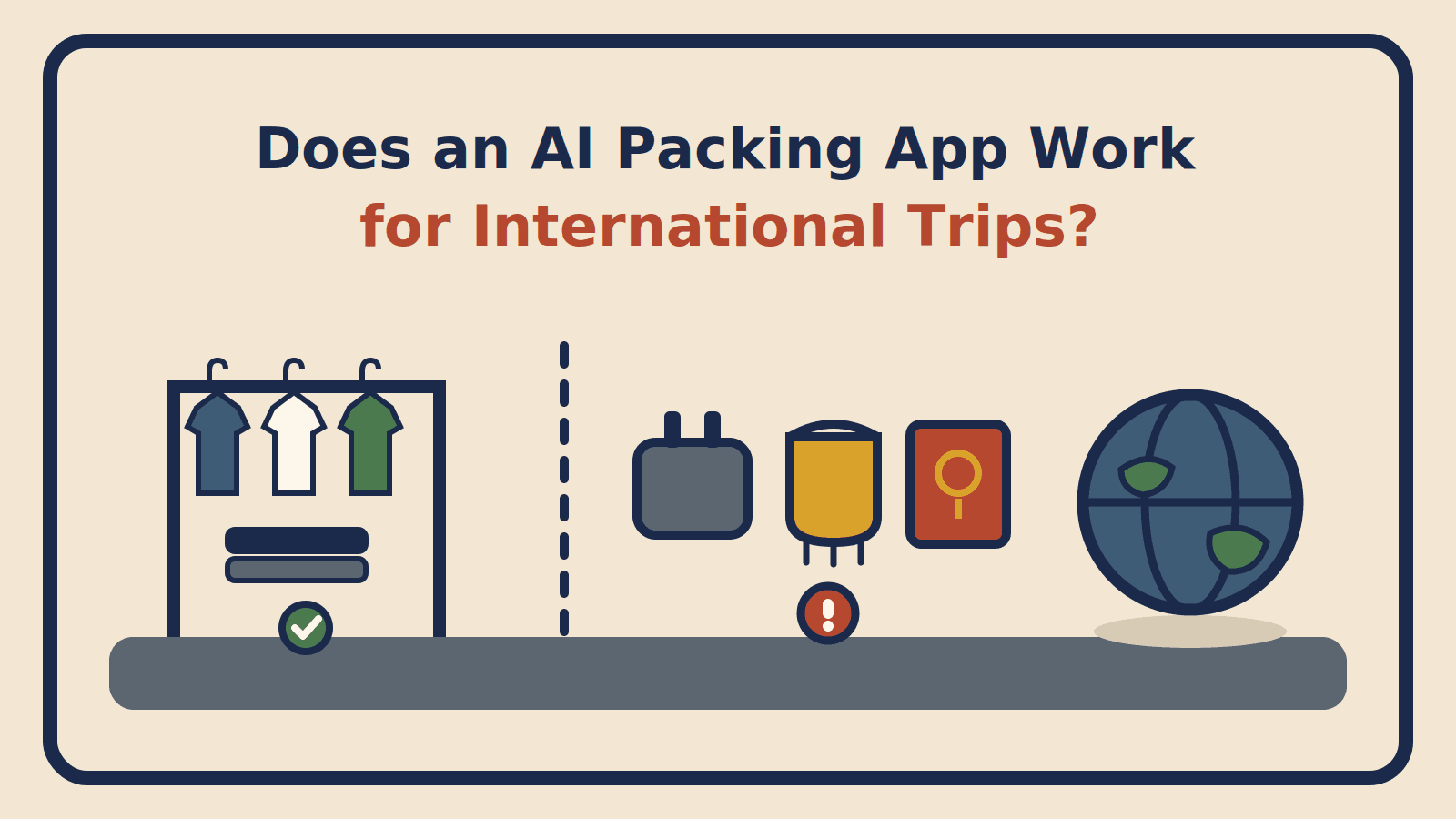
Prefer us on GoogleAn AI packing app splits into two halves when you cross a border, and they fare very differently. One half is essentially unaffected. The other lands in exactly the territory where these systems are documented to be weakest.
Quick Answer
- The wardrobe math travels perfectly: your closet and thermal physics don't change at a border
- The cultural and regulatory half degrades, and research explains why
- AI systems show measurable Western-centric bias in what they know and recommend
- Verify dress expectations, visas, baggage rules and plug standards yourself
- Check offline behavior before you fly rather than at baggage claim
What travels unchanged
The parts of packing that are physics or arithmetic work identically anywhere.
Your wardrobe is the same wardrobe in Osaka as in Ohio. Merino resists odor at the same rate, denim goes the same number of wears before washing, and a shell blocks wind the same way. A system reasoning from your cataloged garments doesn't lose anything by the destination being foreign.
The quantity logic travels too. Eleven days with one laundry stop needs the same number of tops regardless of which country those eleven days happen in. So does the combination check: whether six tops and two bottoms produce enough workable outfits is a question about the clothes, not the place.
And temperature reasoning is universal. A destination running 8 to 14°C needs the same layering system wherever it is.
That covers most of what a packing app actually does, which is why the honest answer to the title question is broadly yes.
What doesn't
The other half is local knowledge, and there's a well-documented reason it's the weak spot.
Research on large language models has repeatedly found Western-centric bias baked into what they know. Navigli and colleagues demonstrated that GPT-4 favors European and North American entities over Asian and African ones in knowledge representation. Work using the CAMeL benchmark found that even models specifically oriented toward Arabic showed strong bias toward Western entities when tested in Arabic, injecting Western assumptions into Arab cultural settings rather than adapting to them. A 2026 audit of AI assistant recommendations measured US-entity favoritism at odds ratios approaching or exceeding 7:1 across both Gemini and GPT models.
The cause is uncontroversial: training data comes disproportionately from English-language, urban, North American and European sources.
Applied to travel, one localization analysis describes the concrete failures, AI recommending nightlife in conservative markets, or suggesting street food without noting whether it's halal during Ramadan. Another research group found chatbots consistently favor well-marketed attractions over locally rooted ones, because the models conflate digital visibility with relevance.
For packing specifically, that maps onto four things worth checking yourself:
Dress expectations. Coverage requirements at temples, mosques and churches, and norms about what's appropriate in public. These vary by country, by site, and sometimes by season, and getting them wrong has an actual consequence: being turned away. Poland's churches, for instance, expect modest dress from visitors of both sexes without requiring a head covering, a distinction our guide to what to pack for a trip to Poland spells out.
Documentation. Visa requirements depend on your nationality, which a generic list doesn't know.
Baggage rules. European budget carriers enforce an under-seat personal item where a US carrier would allow a full carry-on. Same trip, completely different volume budget, the kind of gap that matters on a budget-airline hop between the Christmas markets in Vienna and Munich.
Plugs and voltage. These vary within regions, not just between them. Continental Europe, the UK, Switzerland and Italy don't share one standard.
The practical split
Use the app for what it's genuinely good at: the wardrobe selection, the quantities, the combination check, and the completeness sweep for chargers, documents and adapters. That's most of the work and it's the part that doesn't care about borders.
Verify the four categories above against official or local sources. Government sites for visas, the airline's own page for baggage, a site's own guidance for dress codes.
That division isn't a workaround, it's the correct use of the tool. The same advice applies to AI trip planning generally, where industry professionals consistently recommend treating output as a draft rather than an itinerary.
Where JetKit lands
JetKit's core work is on the side that travels. It builds from your cataloged closet, so the candidate set is your actual clothes; it sets quantities from trip length, laundry access and conditions rather than a per-day count; and it checks that the selected pieces combine into complete outfits. None of that degrades because the destination is abroad.
What it doesn't claim to be is a source of local cultural authority. A system that doesn't know your nationality can't tell you your visa requirements, and one working from general training data shouldn't be your final word on whether a particular site requires covered shoulders.
The useful posture is knowing which half you're relying on. For destinations with specific dress expectations, packing for an unfamiliar dress code and new country, new rules cover the research worth doing yourself.
For apps ranked on international-specific criteria like offline access, see best packing apps for international travel.
Frequently Asked Questions
Do AI packing apps work for international travel?
The clothing calculations do, because your wardrobe and the physics of staying warm or cool don't change at a border. What degrades is local context: dress expectations, what you can buy on arrival, and region-specific baggage rules. Research has documented that AI systems are systematically weakest on non-Western contexts.
Can AI advise on local dress codes?
Treat it as a starting point rather than an authority. Studies show large language models carry a Western-centric bias, favoring European and North American contexts and sometimes injecting Western assumptions into non-Western settings. For anything with a real consequence, like temple or mosque coverage requirements, verify against an official or local source.
What does an AI packing app get right internationally?
Everything driven by conditions and your own wardrobe: how many layers a temperature range needs, how many tops for a given trip length and laundry access, whether the pieces you own combine into workable outfits, and reminders for chargers, documents and adapters.
What should I verify myself before an international trip?
Dress expectations at religious or formal sites, visa and documentation requirements for your nationality, your airline's specific baggage limits, and plug type plus voltage for each country you're visiting. These are the categories where being wrong has real consequences and where generic AI is least reliable.
Does the app work without a data connection abroad?
That depends on the app rather than on AI generally, and it's worth checking before you fly. Roaming is often off, local SIMs take time to arrange, and airport wifi frequently sits behind a signup you can't complete. Test it in airplane mode before departure.
Related
More in Building a Travel Wardrobe.