What's the Best Packing Method for a Family Trip?
September 1, 2026 · 4 min read
Prefer us on GoogleFamily packing isn't a volume problem, it's an attribution problem. One person can pack any way they like because they know what's theirs. Four people sharing two suitcases need to know whose things are whose and find them fast, usually in a dark hotel room at 7am.
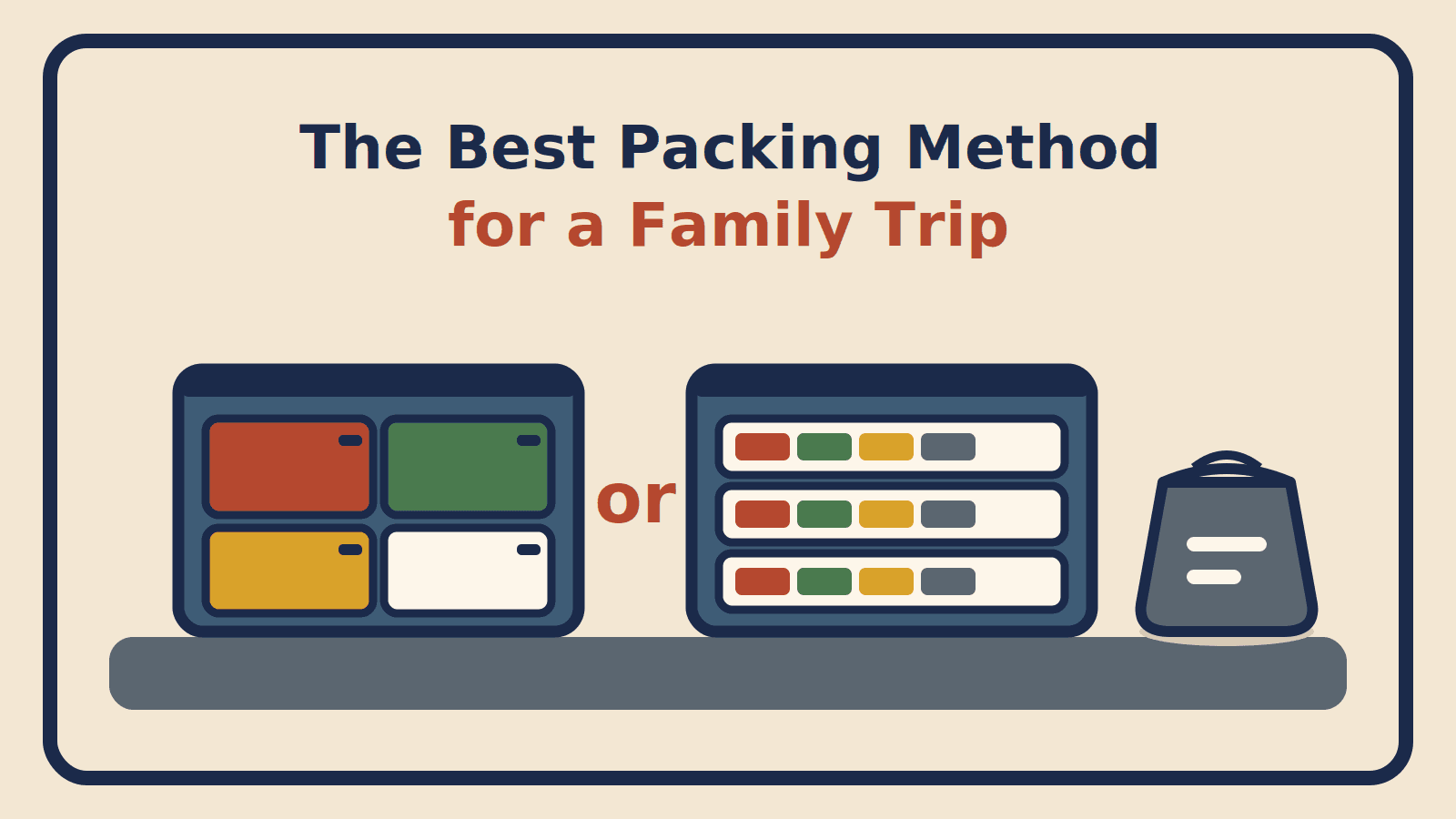
There are two real methods, and experienced family travelers genuinely disagree about which is better.
Quick Answer
- Two methods: one cube per person, or one cube per day holding everyone's outfits
- By person wins when kids dress themselves and you're in one location
- By day wins when you're dressing everyone, or you're changing hotels
- For young kids, bag complete outfits individually. It's the strongest hybrid
- Give dirty laundry its own container from day one, in a color you use for nothing else
Method one: pack by person
Every family member gets a color. All their cubes are that color, in whatever sizes they need. A large one for clothes, a small one for underwear and socks.
The payoff is autonomy, and the parents who use it describe that specifically. One traveling mother told Eagle Creek that her oldest son knows his color and grabs his own clothes to dress himself. Another described color coding as the thing that made it obvious whose clothes were where, quickly, without opening anything.
That matters more than tidiness. A method that lets a seven-year-old dress himself removes an entire task from your morning, every morning, for the whole trip.
Use it when: your kids are old enough to dress themselves, you're staying in one place, and each person needs to access their own things independently.
Method two: pack by day
Everyone's Monday outfits go in one cube. Tuesday's in the next.
A mother of four described doing this for a Disney trip, pulling the next day's cube each evening and laying out clothes for the entire family in one go. Another family traveler gave the sharper reason: on trips changing locations frequently, she keeps the next day's cube at the top of the suitcase so it's accessible on arrival without unpacking anything else.
That second benefit is the one people underestimate. On a multi-stop trip, packing by day means a one-night hotel stop requires opening exactly one cube instead of unpacking four people's luggage and repacking it in the morning.
Use it when: you're the one dressing everyone, the itinerary is tightly scheduled, or you're moving between locations.
The hybrid for young kids
The strongest version for toddlers and small children combines both. One parent of three packs complete outfits individually (shirt, shorts, underwear and socks together in a gallon bag or small cube), one per child per day.
It's more work at home and it eliminates all decision-making at the destination. There's no assembling an outfit from separate cubes and no discovering at 7am that the socks are in the other suitcase. She also plans them by activity rather than by number: travel day outfit, adventure outfit, dinner outfit, backup outfit.
That backup deserves its own mention. With young kids, spills and accidents aren't a risk, they're a schedule. Keeping one extra outfit per child accessible rather than buried is worth the space.
The tension nobody resolves
Standard advice for lost luggage is to distribute each person's clothes across multiple bags, so if one goes missing nobody is left with nothing. That directly contradicts keeping each person's things together, which is the entire point of packing by person.
Both concerns are real, and the workable resolution is to split by bag rather than abandoning the method: put each person's main cube in one suitcase and a smaller secondary cube in another. Everyone keeps their color, and a lost bag costs each person some clothes rather than costing one person all of them.
If you're flying with a checked bag, the more important version of this is that everyone should have a change of clothes in a carry-on regardless of method.
The thing both methods need
A dedicated container for dirty laundry, from the first day.
Whichever method you use, its organization degrades the moment worn clothes start going back into cubes among clean ones. A spare cube or a laundry sack in a color reserved for dirty clothes keeps the system intact for the whole trip and makes unpacking at home trivial rather than a sorting exercise.
For what to actually pack rather than how to organize it, see our guide to packing with kids. And for the related problem of two adults sharing one bag, see couples sharing one bag.
Frequently Asked Questions
What's the best way to pack for a family trip?
Choose between two methods. Packing by person gives each family member their own color-coded cube, which lets kids find and grab their own clothes. Packing by day puts everyone's outfits for a given day in one cube, which makes mornings faster when you're the one dressing everyone.
Should I pack by person or by day?
By person if your kids dress themselves and you're staying in one place. By day if you're dressing them, or if you're changing locations, since you can keep the next day's cube at the top of the suitcase and avoid unpacking at each stop.
How do color-coded packing cubes work for families?
Each family member is assigned a color and all their cubes are in that color, in whatever sizes they need. Parents report that once kids learn their color they can find and grab their own clothes without help, which removes a lot of morning friction.
What's the best method for toddlers and young kids?
Complete outfits bagged individually. Put the shirt, shorts, underwear and socks for one day into one gallon bag or small cube per child, so there's nothing to assemble in the morning. It combines both methods at the outfit level and is the most reliable option for young children.
Where should dirty clothes go?
In a designated bag or spare cube from day one, ideally in a color you don't use for anything else. Without a dedicated container, dirty clothes migrate back among the clean ones, which is the single most common way a well-organized family suitcase falls apart mid-trip.
Related
More in Luggage and Packing Methods.