Best Packing Formula for a 7-Day Trip
August 27, 2026 · 4 min read
Prefer us on GoogleThere are at least five published packing formulas in circulation. Run each of them against a seven-day trip and none produce quite the right answer, because none were calibrated for exactly this length. The useful exercise is doing that arithmetic openly and seeing where each one breaks.
Quick Answer
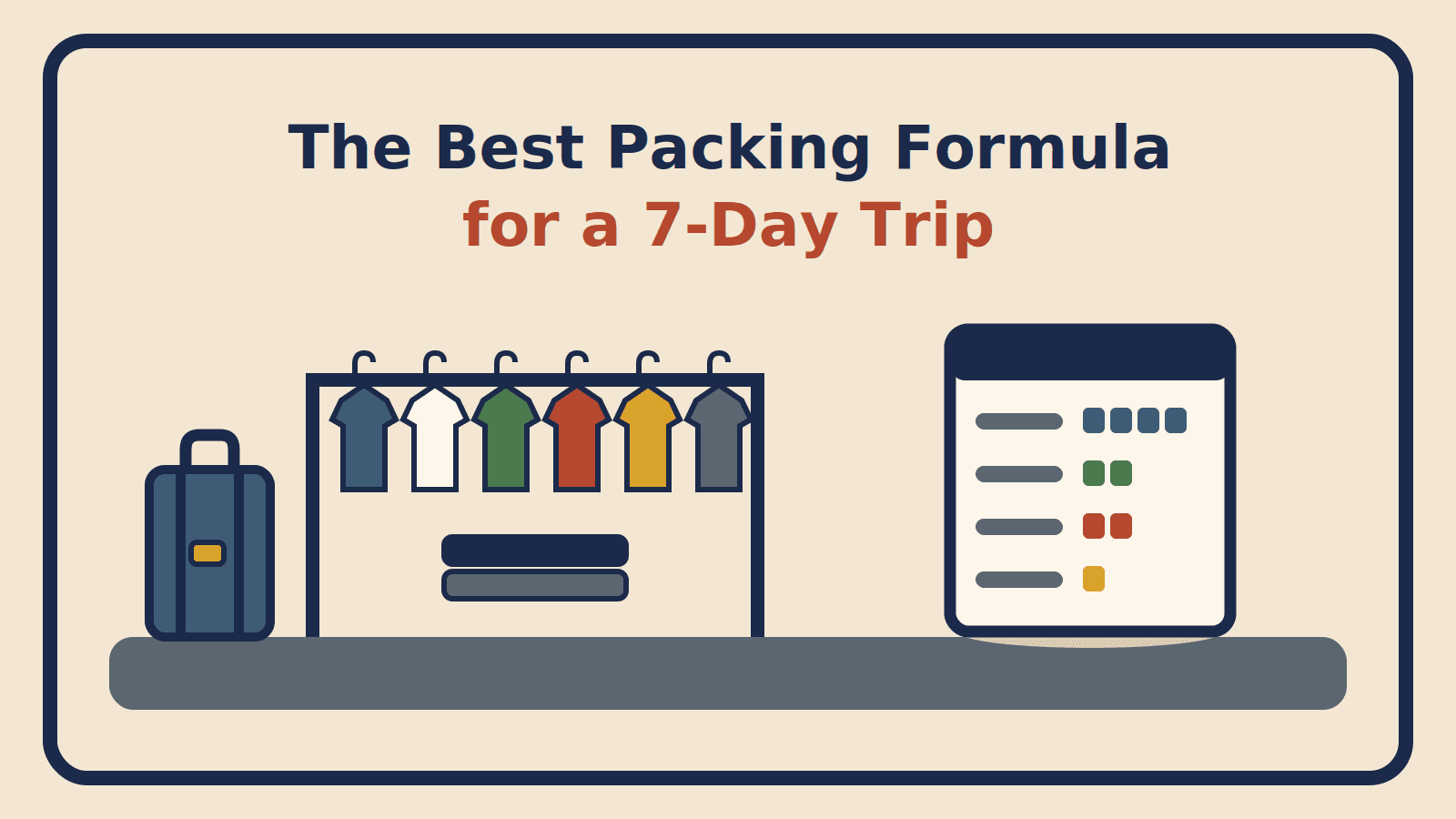
- Six tops, two bottoms, two pairs of shoes, one layer, seven sets of underwear and socks
- That's the Rule of Three ratio for clothing, with base-layer counts corrected upward
- 5-4-3-2-1 over-supplies bottoms and shoes at this trip length
- 1-2-3-4-5-6 gets the non-clothing categories right but under-counts underwear
- One mid-trip wash drops tops to four and base layers to four or five
Running each formula against seven days
5-4-3-2-1 gives five tops, four bottoms, three pairs of shoes, two accessories, one extra. The tops are close. The four bottoms are the problem: pants go several wears before washing, so two covers a week comfortably and four is roughly double what's needed. Three pairs of shoes is also generous when shoes are the bulkiest thing you pack. This formula is explicitly built for one to two weeks with a laundry stop, so at exactly seven days it's over-provisioned on the heaviest categories.
1-2-3-4-5-6 gives one hat, two pairs of shoes, three bottoms, four shirts, five pairs of socks, six pairs of underwear. This is the best of the named formulas on non-clothing, and its four shirts matches what t-shirt guidance independently arrives at for a week. Where it fails is base layers. Six pairs of underwear for a seven-day trip is short by at least one even before you account for a spare, and five pairs of socks has the same problem.
The Rule of Three, three tops per bottom, gives six tops and two bottoms for a week. This is the closest fit of anything published, because it's a ratio rather than a fixed count, so it scales to whatever trip length you apply it to.
3-2-1 is three tops, two bottoms, one pair of shoes. That's a weekend formula and it's genuinely good at that job, but three tops across seven days means wearing each one more than twice, which most fabrics won't support.
6-5-4-3-2-1 is built for extended trips and over-supplies badly at a week.
What the arithmetic actually supports
Combining the ratio that works with the counts that hold up elsewhere gives this:
Six tops. Six against two bottoms produces twelve combinations, comfortably covering seven days with slack. Worth clarifying, since it looks like it conflicts with the t-shirt guidance of four: six tops means roughly four t-shirts plus two non-tee tops, typically a button-down and a knit or long-sleeve. The four-t-shirt figure and the six-top figure describe the same wardrobe at different levels of detail.
Two bottoms. Levi's own care guidance puts denim at about ten wears before washing, and non-denim pants run three to four. Either way two pairs covers seven days, and bottoms are the heaviest thing in the bag, so this is where over-counting costs most.
Two pairs of shoes, one worn on the plane. Shoes are the least compressible items you pack.
One layer. A jacket, cardigan, or overshirt that works across every top in the palette.
Seven sets of underwear and socks if you won't wash, four or five if you will. Base layers are the one category that genuinely scales one-to-one with days, which is exactly where the formulas that treat all categories alike go wrong.
Why seven days breaks the formulas
Every one of these formulas assumes a laundry posture without stating it. Below five days nobody washes anything and the count is simply days. Past ten days everyone washes and the count stops scaling with trip length entirely. Seven days sits precisely on the boundary, which is why the published formulas disagree most sharply at this length: some assume a wash and some don't, and none say which.
That's the decision worth making before you pack rather than after you arrive. Committing to one mid-trip wash takes you from six tops to four and from seven sets of base layers to four or five, which is the difference between a full carry-on and a comfortable one.
For the underlying method rather than the seven-day application, see what the 5-4-3-2-1 packing method actually is and the shorter four-category adaptation. For the outfit-count version of this question, see how many outfits you need for a 7-day trip.
Frequently Asked Questions
What's the best packing formula for a 7-day trip?
Six tops, two bottoms, two pairs of shoes, one layer, and seven sets of underwear and socks. That comes from applying the Rule of Three ratio to the clothing and correcting the base-layer counts, because no single published formula is calibrated for exactly seven days.
Does the 5-4-3-2-1 method work for a week?
Partly. Its five tops and one extra piece are about right, but four bottoms is roughly double what a week needs, since pants go multiple wears before washing. Three pairs of shoes is also generous for seven days. It's built for one to two weeks with laundry, so at exactly seven days it over-supplies.
What about the 1-2-3-4-5-6 rule?
It's closest on the non-clothing categories, allocating two pairs of shoes and one hat sensibly, and its four shirts matches what t-shirt guidance suggests. Its weak point is base layers: six pairs of underwear is short for a seven-day trip with no laundry, where you want seven to nine.
How many outfits does this produce?
Six tops against two bottoms gives twelve top-and-bottom combinations, before a layer or different shoes change how any of them reads. You need seven, so there's meaningful slack for a spill or a change of plan.
Do I need to do laundry on a 7-day trip?
No, but one wash midway lets you drop from six tops to about four and from seven sets of underwear to four or five. Seven days is the exact point where laundry stops being necessary and starts being merely useful, which is why the formulas diverge most at this length.
Related
More in Packing by Trip Length.